
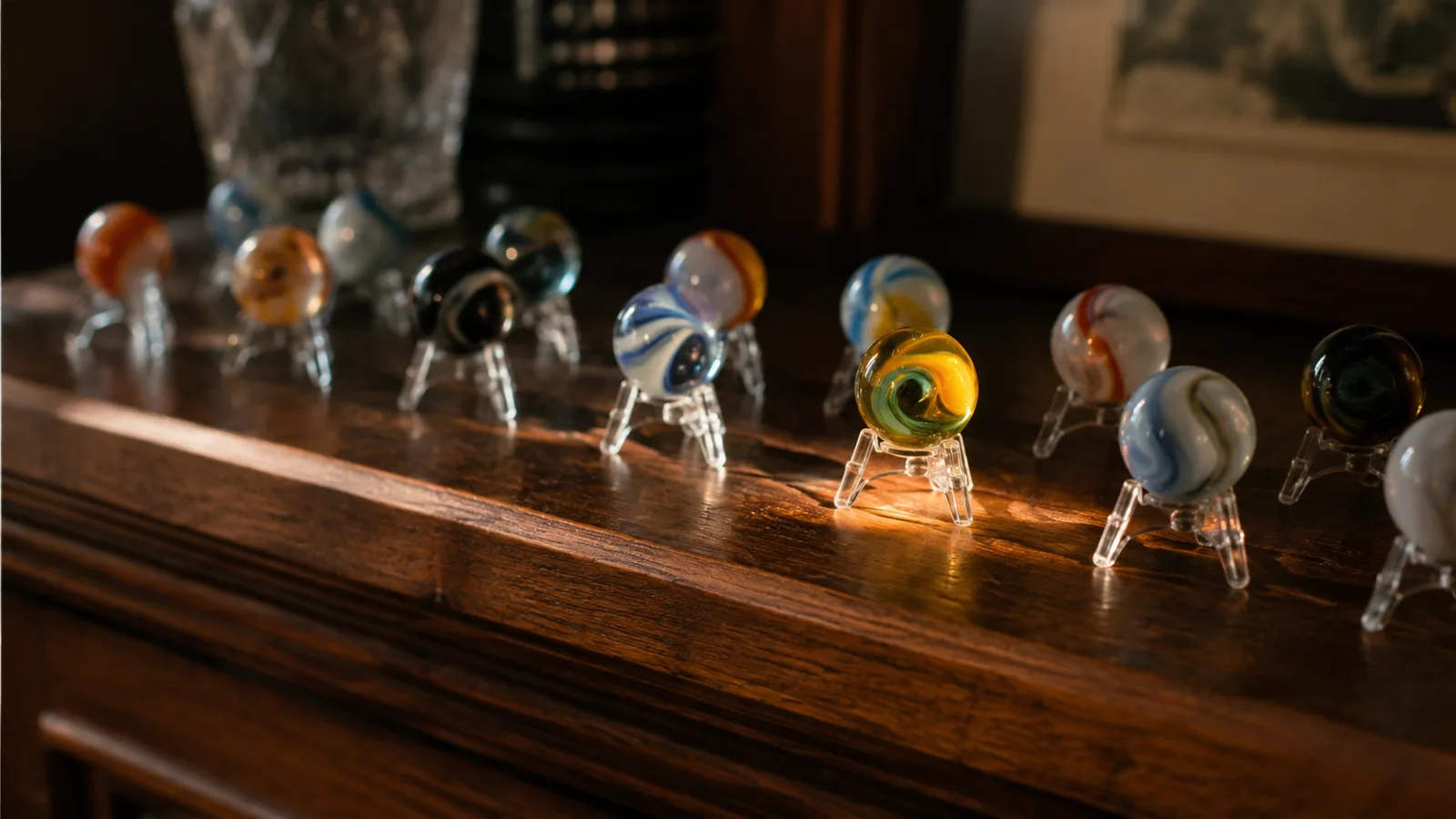
A year ago my best marbles were living in a cardboard tray under the counter, and every time Ruth asked to see the swirls I had to carry the whole tray out, set it down slowly, and hold my breath that nothing rolled off onto the tile. Then a customer at the shop asked if I kept any out where people could actually look at them. That question sat with me for a week. A collection nobody sees is just a box you are storing, and I had been storing mine for going on two years.
I tried the obvious things before I landed on clear acrylic easel stands. Laying marbles flat on felt did nothing, they just sat there like loose candy. I tried a wooden tray with divots, that was better but the tray ate up the whole shelf and nothing between the marbles was visible. I tried propping a handful against a bookend, which looked exactly as careless as it sounds and left a chip on a good yellow oxide that I am still annoyed about. The LRANFOW clear acrylic easel stands, a 12-pack in three sizes, were the thing that finally got them out of the tray and into the light where they belong.
The Quick Verdict
After a year of daily use and constant re-arranging on the shop shelf, these clear acrylic easels lifted my best marbles out of storage and onto the light without a single one rolling away or picking up a scratch.
Amazon Check Today's Price →If your best marbles are still sitting in a box under the counter, this is the cheap thing that gets them out.
A 12-pack of clear acrylic easel stands in three sizes is the lowest-cost way I found to stop hiding the pieces you care about. I bought them a year ago to display mine and they have been on the shelf ever since.
Amazon Check Today's Price on Amazon →How I've Used Them
I am Lonnie, I am 57, and I run a small shop in central Ohio with my wife Ruth where we buy and sell vintage marbles, glassware and small glass. I have been collecting since I was eleven, when a carnival vendor dropped a bag of shooters on the ground and told me to keep them. These LRANFOW stands went to work the week they arrived, and they have been in daily use ever since.
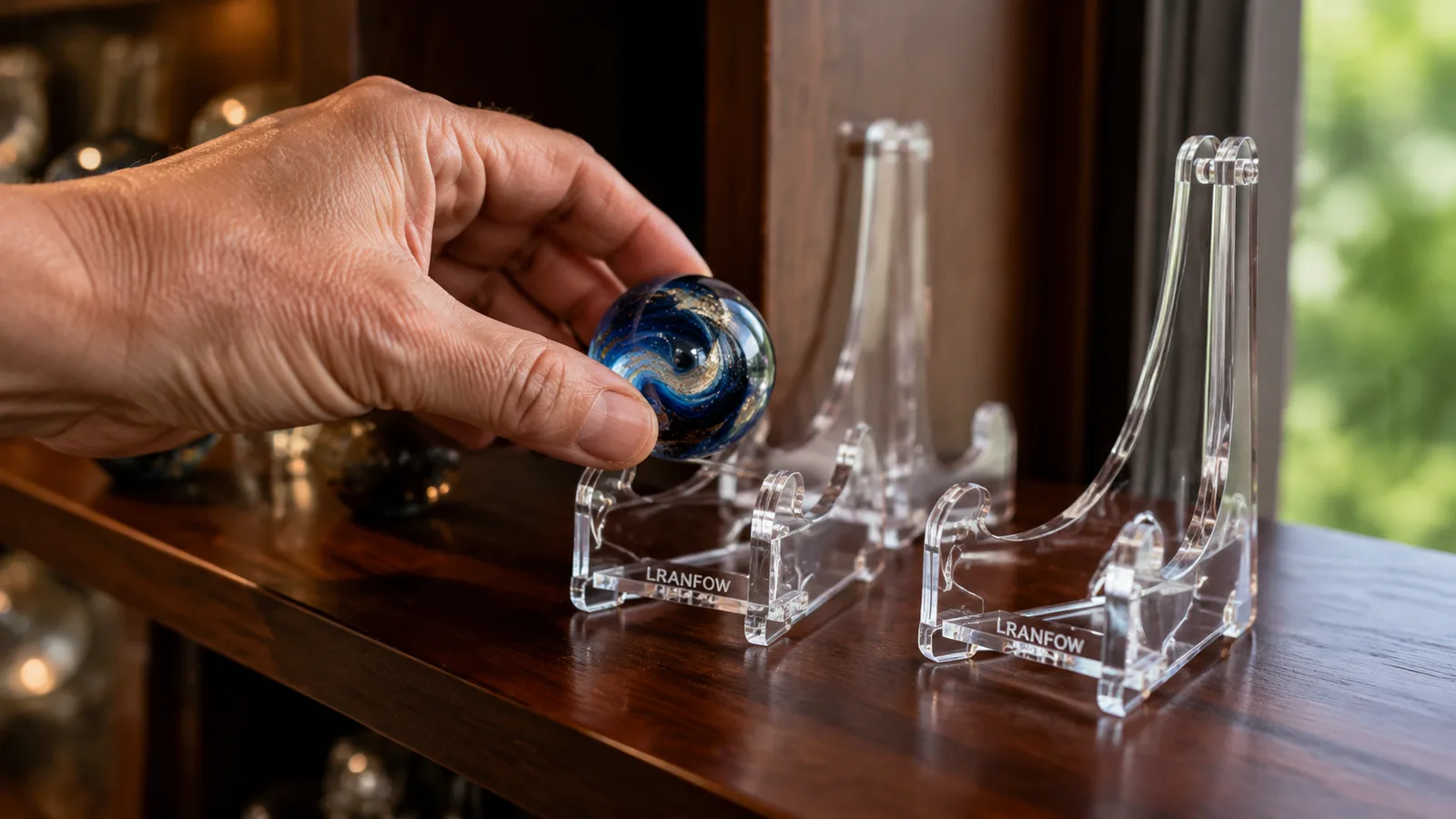
The pack has three sizes, four of each. The smallest takes your standard shooter up to about three quarters of an inch and holds it in a shallow rounded notch. The middle size is the workhorse, it swallows a 25 millimeter diamond or a good sized swirl without the polish touching anything but the edge of the notch. The largest stands are for my two prize pieces, oversize easter eggs and apples too big for a normal stand; those big ones hold a roughly two inch marble well over an inch off the shelf.
I do not just leave them static. I rotate the front row at the shop every few weeks, pull a piece when a customer buys it, swap in a new one from the stock tub. Over the year those twelve stands have been assembled and taken apart dozens of times. They click apart into the flat backer and the angled face, and they snap back together just as easily. That was the first surprise, how well they survived being handled constantly and not just sitting pretty.
The rhythm after a year is unremarkable, which is the compliment. The stands go under the front row on a Sunday when we reopen, they hold through a week of foot traffic and a few sales, and a month later I pick the emptiest sector and swap in fresh pieces from the stock tub. The glassware moves steadily. The stands just keep holding whatever round thing I ask them to, and when a customer buys the marble off one, I pull the empty easel, wipe it, and set the next keeper in it within a minute.
What the Stands Actually Fix
The first thing is the rolling. A round marble on a flat shelf rolls the moment the floor shakes, a truck goes by, or someone shuts a door a little hard. In a notch on an easel it stays put, full stop. I have had the front row up for a year through a hot Ohio summer and a shop full of foot traffic and only ever had to pick up two marbles, both of them because I set them unbalanced in the bigger stands myself.
The second is the light. A marble lying on felt catches almost none of it, you see a dark dome. Standing upright at an angle, the polish catches the window or the shop lamps and the swirl actually shows. That is the whole point of a good marble, seeing the cane lines buried inside it, and you cannot see those lying down. The clear acrylic does not block the view the way a solid holder does, which is why I settled on these instead of a wooden block with a hole.
By winter the light in the shop drops, and that is when the clear design earns its keep most visibly. The same swirls that read as dark domes on a felt tray pick up the lamp from underneath because there is nothing solid between the bulb and the glass. I noticed it first on a grey January afternoon, and it has been the argument for keeping these over any solid holder ever since.
The third is that they make a collection read as a collection. Twelve marbles on clear stands look deliberate in a way the same twelve loose in a bowl never will. When a customer at the shop leans in to look, that is when a piece sells. I moved noticeably more mid-range marbles once I started showing them this way, not because the stands changed the marbles but because people could finally see them.
The Sizing and the Badges
Underside of each stand there is a molded brand mark and a little ridge. The ridge is fine, it is hidden by the shelf, but I will say the brand embossing is the kind of detail a careful collector notices. On the big stands it is faintly visible over the lip if you are looking at the back edge. For shop display nobody cares. For a clean photography setup you might find it worth turning the large stands so the badge faces the back of the shelf.
Sizing is where you have to do a little thinking. The pack gives you twelve in three sizes but does not label them, so the first sorting evening you will be holding stands up to marbles trying to guess which is which. Once sorted they are easy to tell apart by height, short middle tall. My habit now is to keep the four largest reserved for the two prize pieces and two spares, and let the middles do the daily work.
Do They Hold Up to a Working Shop
I will be plain about durability because that is what a year of real use tells you that a listing photo cannot. The LRANFOW acrylic is rigid, not brittle, and it has not yellowed sitting under the shop lights and a north window. I have dropped one stand onto a tiled counter from counter height and it bounced, no crack, a tiny scuff on the foot that you cannot see once it is sitting. I have not had a foot break off or a notch chip despite a year of snapping pieces in and out.
The one real wear is on the finish. Where the stand slides against the shelf edge when I reset the row it picks up faint hairline scratches over time. They are polished out with a soft microfiber and a dab of plastic polish in about a minute, and they never touched the marbles. If you are precious about the stands themselves, put them down and pick them up straight instead of dragging, and they will stay clear for years. If you are the sort of collector who does not like seeing any wear on a holder, give them a wipe down with warm water and a microfiber when it catches your eye and they will stay looking new all year.
Putting Them to Work With the Glassware
Because I also sell vintage glassware, I will tell you these stands are not just for marbles. A small perfume bottle or a heavy round paperweight sits fine on the middle stands, and when I ran out of dedicated holders one weekend I used a few to raise a small cranberry glass paperweight at the front of a shelf so it caught the light. They are unassuming enough that they do not upstage the piece, which is exactly what you want from a holder.
The line I would draw is with anything flat or very wide. A lava lamp style base or a shallow dish will not balance in a round notch, they need a flat platform. Stick to round, gently heavy pieces and these stands behave themselves. For every marble in the collection, honestly, they are perfect. Same holds for a round candy dish or a plain mercury glass orb, as long as it is round and not too heavy for the base. The LRANFOW stands broaden the display without announcing themselves. That is the niche they serve and they serve it well.

What I'd Have Done Differently
The honest part. These stands are not built for the biggest oversize marbles, nothing over roughly two inches will sit right, the notch is too shallow and the base tips. My two vintage apples did fine because they are on the small end of oversize, but a three inch club piece will not stay. For those you still need a ring stand or a flat base with a well.
The acrylic itself is smooth but it is not a magic protector. If you stack stands face to face in a drawer they will hairline scratch each other, and if you set a gritty marble down hard you can still ding the base. I keep the contact point between a polished marble and the acrylic perfectly clean, a single grain of sand between them would be an engraved line you cannot take out. A soft brush over the shelf once a week before I reset the row takes care of this.
What I Liked
- Holds a round marble steady and upright, no rolling even with floor shake and foot traffic
- Clear acrylic shows the swirls and cane lines that make a marble worth owning
- Three sizes in one pack cover shooters up through oversize pieces
- Snap apart and reassemble cleanly, survive constant re-arranging
- Cheap enough that losing one to a clumsy day is not a crisis
- Make a loose pile read as a deliberate, sellable collection
Where It Falls Short
- No size labels, so the first sort is fiddly
- Largest stands tip on anything over about two inches
- Brand embossing on the back is faintly visible if you look for it
- Acrylic scratch each other if you store stands touching face to face
- You still need a ring or well stand for truly vast club pieces
A year and not one of my best marbles has rolled off, slipped out of the notch, or picked up a scratch. That is the whole review right there.
Who This Is For
These stands are for the collector who has been keeping their best pieces in a box because nothing felt good enough to put them in. Also for the small dealer showing marbles at the front of a store where every catch of the light might make a sale. And honestly for the person who just wants the good swirls off the nightstand and up where they can actually admire them. The three sizes mean one pack covers a shooter collection top to bottom.
Who Should Skip It
Pass on these if you deal mainly in club-size oversize marbles over two inches, you will need sturdier well-based stands. Pass if your display space is in direct line of a window all day, because acrylic yellows and cloudses with years of harsh sun, same as any plastic, and these are not the piece for a bright south-facing sill. And if you only ever store marbles in the dark and never look at them, you do not need a display at all, and saving the shelf space matters more.
Would I buy them again. I already have. I keep a second 12-pack in stock at the shop for when customers see the front row and ask what is holding them up, which happens more than I expected. They are small, they are cheap, they disappear visually, and they let the marble do the talking. After a year of daily use that is the strongest thing I can say for them. Get your good pieces out where the light can reach them.
One 12-pack is the whole fix. Your good marbles have waited long enough.
Same three sizes I have had in daily use for a year at the shop. Get your best pieces off the tray and into the light, today's price is still small enough that it barely counts as a splurge.
Amazon See Today's Price on Amazon →