

If you collect or sell marbles long enough, you end up with the same problem I did: a tub of loose glass that all runs together. Ninety corkscrew pinks sitting on top of eighty blue cat's-eyes on top of a layer of chipped commons you meant to weed out last year. Every time I reached in to pull a shooter for a customer, I rearranged the whole pile, and every rearrangement was one more chance for a good marble to pick up a ding from its neighbor. So last fall I finally did what I should have done a decade earlier. I bought a 34-slot adjustable divider box, the DUOFIRE, and I sorted the whole mess.
This box is sold as a jewelry and bead organizer, which is how most people use it. But for a marble collector, the 34 adjustable cells turn out to be nearly ideal, with one or two honest catches I'll get to. I've been working mine hard since September, sorting, staging and packing stock, so this is less a first impression and more a report from a year in. If you have a jar of mixed marbles and you're tired of fishing through it by feel, read on.
The Quick Verdict
A simple, sturdy sorting box that earns its place if you work with loose marbles at all. The dividers hold well enough for bench work, but treat it as a working tool, not a vault.
Amazon Check Today's Price →Stop Fishing Through a Tub of Loose Marbles
One 34-cell box turns a mixed mess into rows you can see and sell from. That is worth more than the box costs.
Amazon Check Today's Price on Amazon →How I've Used It
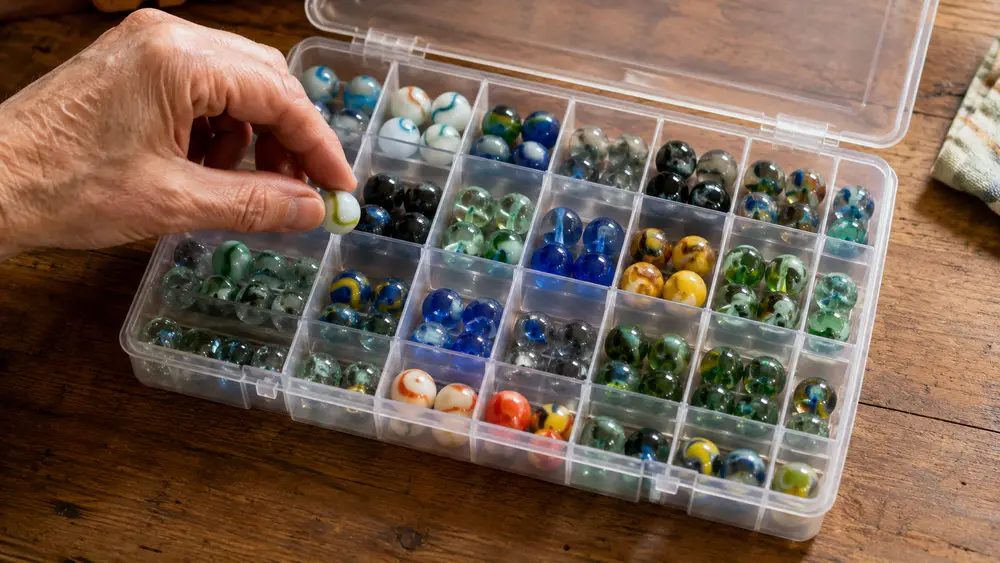
To be clear about what this is: a clear plastic tray with a black grid inset and a fitted lid, the whole thing about the size of a sheet of notebook paper and a couple of inches deep. It comes as one pack with the dividers already snapped in, and you move them around to make bigger slots. The routing I settled on took maybe twenty minutes the first afternoon, and I have not touched the dividers since.
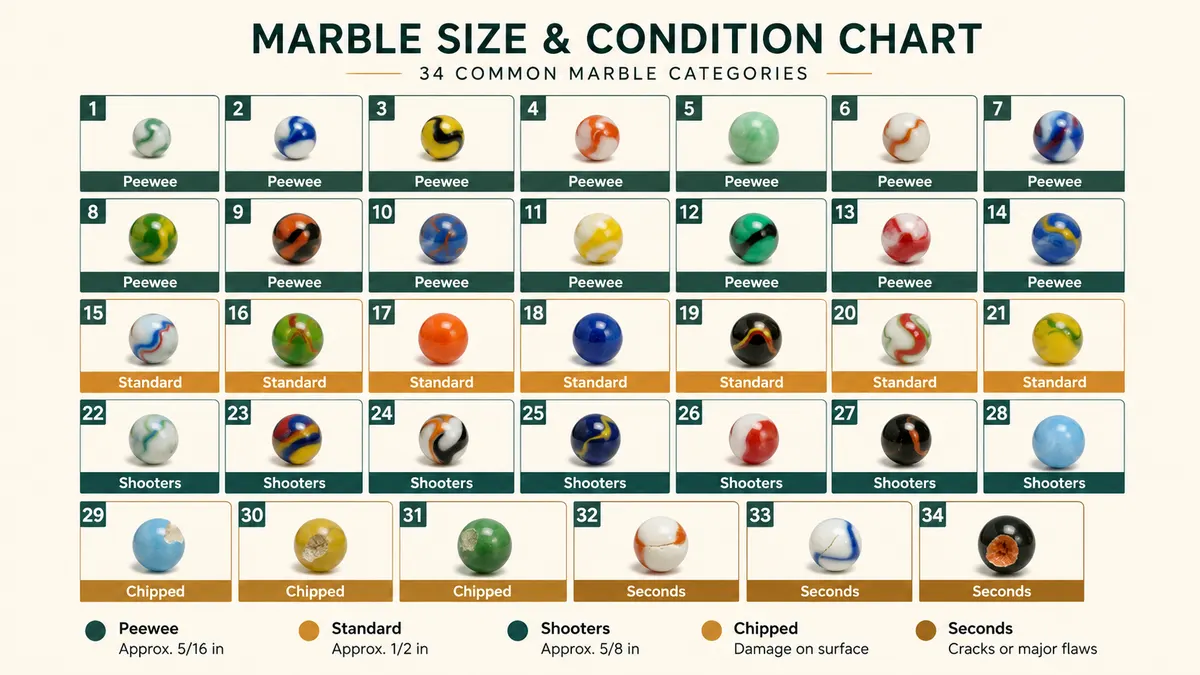
I split the cells by what matters to a dealer more than anything: size first, then condition. Peewees up in the left corner, regulars down the middle, shooters and jumbos along the right. The two or three cells I could not afford to waste on broken pieces I left for seconds, marbles with a visible chip that are still worth pulling for a child's bulk bag. Labeling would have been easier on the fingers, but I found that once the rows were set, I read them faster than any sticker.
The lid is transparent, so I can see exactly what is in each cell without lifting it. That sounds like a small thing until you have spent a decade lifting lids. It has cut the time I spend on the bench in half, and it has almost entirely ended the grief of watching a good marble roll off the stack and under the drawer.
A Season of Daily Wear
The honest test of any tool is the season, not the first afternoon, and this DUOFIRE has now seen mine. It has been handled thousands of times, reached into for customer orders, lifted to the shelf, brought back down, and set in the same corner of the bench, and through all of it the plastic has stayed straight and the dividers have stayed where I put them. That is more than I can say for the egg-crate trays I tried years ago, which warped in the first summer heat and let the smalls drift under the seams.
What surprised me most was the seams. I expected a cheap organizer to flex and go sloppy around the edges the way cheap organizers do, but the teeth that hold the dividers have kept their bite. The box sits flat, the rows stay square, and nothing has cracked in the cold of a February shop or the humid stretch of a Columbus July. For a working tray that lives out where it is bumped and set down, it has held its shape better than I had any right to expect at today's price.
The 34 Grids and How the Dividers Really Behave
The dividers are the whole story, so I watched them closely. They press into a base grid of fine teeth, which means you are not stuck with thirty four identical squares. Want a long slot for a run of the same pink? Pull the teeth out and you have got it. Want one big cell for a pound of peewees? Snap out a section and it is yours. That flexibility is what sold me, and it is what carries it through a season of daily sorting.
Honest note on the hold: they stay put for bench use, no question. But they are not welded in. If you pick the box up by its edges when it is only half full and tip it, the loose dividers can shift and the small stuff can ride under a seam. I learned to carry it two-handed and near level, and I do not shake it to settle the marbles the way I might a bag. Treat it as a working tray and it treats you fine.
One real limit worth saying plainly: the cells are sized for standard game marbles and beads, not for the big clear jumbos and large handmade shooters collectors seek out. A marble over about 20 millimeter sits proud of the cell rim, which makes the lid refuse to close cleanly. If your stash runs to big shooters, keep a second, shallower home for those rather than jamming them in.
What Sorting My Own Stash Taught Me
The first sort took the better part of a Saturday, and it told me more than I wanted to know. I had told myself my loose stock was mostly intact. Once it was laid out in rows, I found a full cell of chipped pieces that had been quietly dinging everything else for years, and a surprising number of small peewees I had let slide under larger marbles. Getting them apart did more for my collection than any single nicer marble I bought that fall.
It also changed how I price at shows. With the stash sorted, I can answer a customer's question in seconds instead of squinting into a tub. Corkscrew pinks by the dozen, plain swirls by the dozen, a couple of tigers in their own cell. The speed alone has paid for the box a dozen times over. If you sell, you will feel this immediately.
The Second Box I Bought Anyway
Halfway through the season I ordered a second one, the same DUOFIRE model, and that tells you a lot about how the first earned its place. One box now holds the working sort, the glass I am actively pricing and moving, and the second holds the backlog I have not gotten to yet, each same-size group stacked so the bench never looks like a bomb went off. Because they nest and the price was modest, splitting the work into two trays cost less than a pound of good commons, and it has kept the bench clear through the whole of sorting season.
Packing for a Sale or a Move
I would not carry my best stock to a show in this box by itself. The lid snaps shut but it does not lock, and the plastic is light enough that a full box hitting a parking lot would be a sad thing. What I do is load the sorted box into a handled tote with a cloth over the top, and it rides fine. For anything of real value, I still double-box it the same way I do vintage glassware, with padding between each piece.
Inside the shop it earns its keep differently. I keep one box as the working sort tray and the spare for whatever batch I am processing next. Because they stack and the price is modest, you can buy a few and split by era or by intended use without feeling guilty. That is exactly what I did, and it has changed how the bench feels entirely.
How I Keep It From Wearing Out On Me
It is not the kind of thing that repays neglect, so I keep three small habits. I carry it two-handed and level, never by the corners when it is half full, because that is the one way a divider can shift. I never stack anything heavy on the lid, since the plastic is light and there is no reason to test it. And I keep the box out of direct sun on a low shelf, not because the glass needs it so much as because I want the tray itself to stay clear and unyellowed for however many years it serves.
That is the real pitch for a box like this, and it is a quiet one: it asks almost nothing of you, and it keeps paying back as long as you give it a level, shaded place to sit. I have not thought about the DUOFIRE all fall, and that absence of thought is exactly the point. The day a storage tool stops being something you manage and just holds your marbles is the day it has earned its corner.

The Light Has the Final Word
One thing I want other collectors to hear, since it is easy to miss: how you store marble stock matters as much as how you display it. Sun through a window will fade even glass given enough years, and strong light on the bench makes it harder to read a marble's true color anyway. So I keep my sorted boxes on a low shelf out of direct sun, not on the windowsill. The clear lid is handy, but it is not a reason to park the box in the light.
The first sort showed me a full cell of chipped pieces that had been quietly dinging everything else for years.
What I Liked
- Thirty-four adjustable cells, so you tailor the layout to your own mix of sizes and conditions
- Clear lid shows contents at a glance, cutting bench time in half
- Dividers snap in and out to make bigger slots in seconds
- Light, stackable, and cheap enough to buy several and split by category
Where It Falls Short
- Dividers can shift if you carry a half-full box by its edges and tip it
- Cells too small for jumbo and larger handmade shooters to sit below the lid
- Thin plastic and a snap-shut lid mean it is a bench tool, not a travel vault
- Small peewee marbles can ride under a divider seam if you settle the box roughly
Who This Is For
This box is for anyone who keeps a mixed lot of marbles and wishes they did not, which, honestly, is nearly every collector I know. If you buy bulk lots to pick the good ones out of, or you sell and need to find a given size on the spot, the 34 cells will do more for you than a display case will. It is a working tool for the bench, priced to match, and it is the kind of thing you will reach for every single day.
Who Should Skip It
If your whole collection fits in one small jar and you like it that way, you do not need this. If your stock is mostly large handmade shooters, the cells will frustrate you, since the big pieces will not sit below the lid. And if you were hoping for a locked, padded, waterproof case to ship valuable marbles in, this is not that, and you will be disappointed. It is a sorting tray. Bought for what it is, it does the job.
If I sound even-handed about the limits it is because the limits are real but small, and the good is real and daily. This box will not hold jumbos and it will not survive being treated like luggage, but I never needed it to. I needed one place where my loose glass could finally stop rolling together, and after a season the DUOFIRE is still that place, sitting at the front of my bench where every job starts.
The second box I bought myself, and I do not regret it. One lives on the workbench for the pieces coming out of a purchase, the other holds the shop stock I mean to price. Having two means I can sort into one and offload from the other without the two habits ever mixing, and that is the small thing that keeps the whole system from turning back into a pile.
A Year Later, It Still Sits at the Front of My Bench
If you have a tub of loose marbles going to waste, a 34-cell box is the cheapest good change you can make. It did more for my bench than any fancy piece I bought that year.
Amazon Check Today's Price on Amazon →