
The short answer, because that is what you came for: for grading a marble and for checking the seams and chips on glassware, the JARLINK 30x jeweler's loupe beats a plain hand magnifier, and it beats it by more than the crowd would expect. I have carried both for the better part of my adult life, first because I had them, later because I found out which one I reached for and which one stayed in the drawer. This is that honest split, not a salesman's answer.
The catch is that a magnifier is not wrong, it is just answering a different question. A hand magnifier shows you a lot of surface at once. A jeweler's loupe shows you one small patch of surface at high power, and that is exactly the difference that decides a grading job. So let me put the two up beside each other the way I would at the bench, and let the pieces speak for themselves.
I want to be plain that I am not one of those people who reaches for the loupe and forgets a magnifier ever existed. Both have sat on my bench for years, and both will go on sitting there. The honest description of my own habit is that the hand glass comes out first when a box of marbles lands, because it shows me the whole of it at a glance and tells me which two or three pieces are worth pulling aside. Then the loupe comes out for those two or three. So when I say the loupe wins for grading, I mean it wins the part of the job that decides the money. That distinction matters, and it is the part most loupe reviews skip.
| 30x Jeweler's Loupe | Plain Hand Magnifier for Grading Marbles | |
|---|---|---|
| Magnification | 30x and 60x on a fold-out lens, made to get right up against a surface | Usually 2x to 10x, made to see a broad area at arm's length |
| Field of view | A small, coherent patch about the size of a marble's face | A big generous circle you can sweep across a whole piece |
| Built-in light | Small LED ring that lights exactly the patch you are looking at | None, unless you set a lamp behind your shoulder |
| Where it sits | Held against the eye socket, both hands free to turn the piece | Held in one hand with the piece in the other, arms out in front |
| Best for | Finding chips, crazing, seams, and a marble's interior swirl | Reading the maker's mark on a vase or scanning a big glass bowl |
| Ease for tired eyes | Short, intense spells, straining for close detail | Easy on the eyes for longer, relaxed looking |
| Pocket fit | Folds flat, rides in a shirt pocket or the watch pocket | Bulkier, needs a bag or a case on a loop |
| Can it scratch the piece | No, the frame never touches the glass if held correctly | No, but the broad frame is easier to knock against a rim |
What a Jeweler's Loupe Actually Is
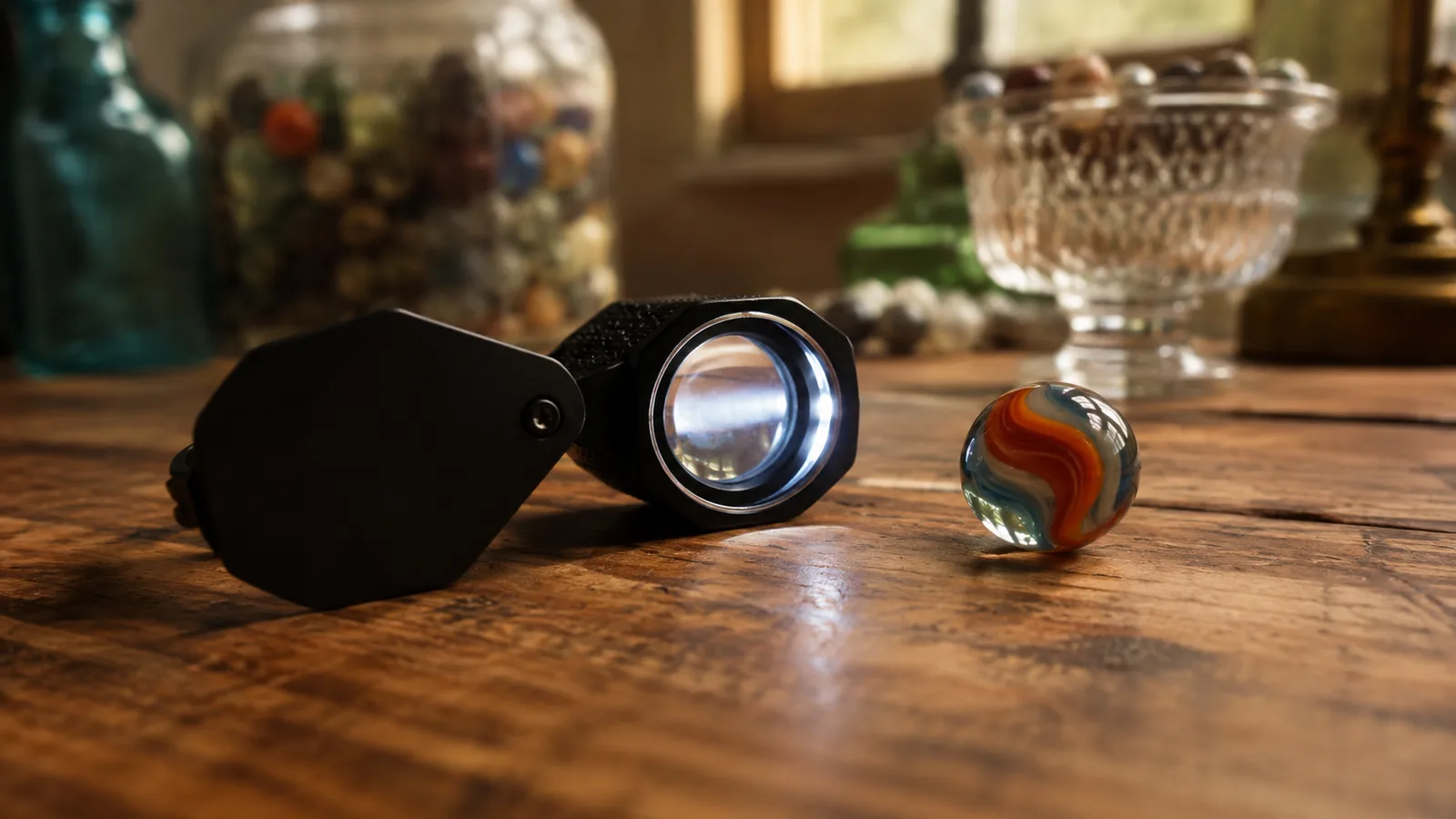
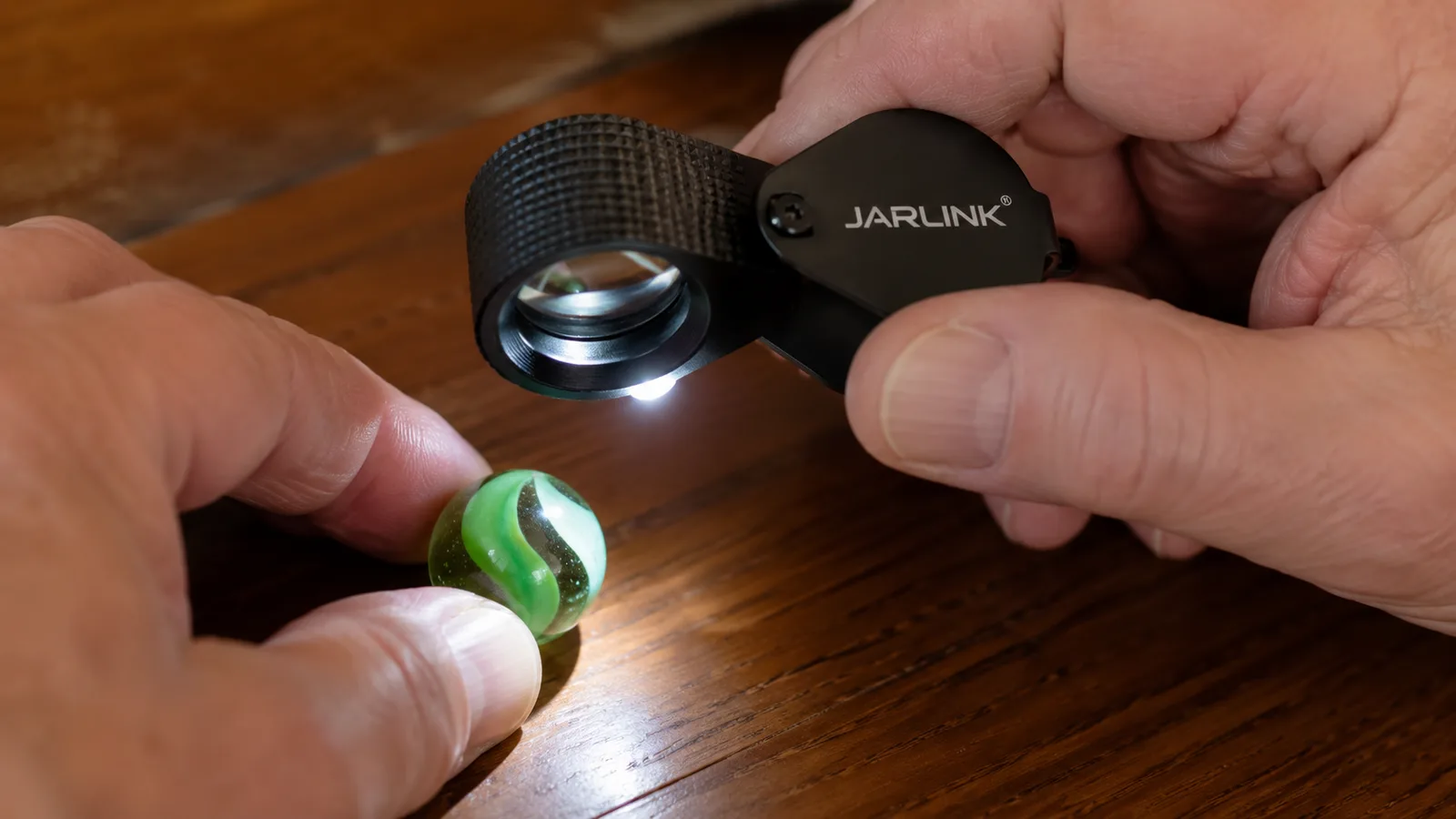
Before the money argument, let me tell you what you are really holding, because a lot of reviews never get to it. A jeweler's loupe is a small folding magnifier meant to be held against your eye socket, not out at arm's length like a magnifying glass. This JARLINK one is a two-lens affair, a 30x and a 60x folded into a little metal shell, with a ring of LED around the lens. You press it to your eye, hold the piece in front of it close enough that the light just about kisses it, and you look.
The genius of it is the working distance. A hand magnifier needs six, eight, twelve inches between you and the glass to focus. A loupe works at barely an inch, which means the best bright light in the room, the light coming off the thing itself, is right where you need it. And with an LED on the lens you are not dependent on the bulb over the bench, which matters when you are out at a flea market or in some elderly estate full of 40-watt lamps.
Now the honest limitations, because nobody is served by a loupe that is all praise. At 30x you are trading away all context. You see a half-inch circle of marble and nothing else, and 60x is a smaller circle still. It is tiring to hold at the eye for long stretches, and if you press too hard the frame can nudge against the glass before you notice. It is a close-in instrument for close-in work, not a companion for idle browsing. That is fine, as long as you know going in that that is what you bought.
Where the Jeweler's Loupe Wins
The loupe wins on the exact thing this hobby turns on: seeing what is wrong before you spend. A chip on a marble's crown, a hairline crack running up a seam, the faint crazing on a vintage shooter that drops its value, none of these show up at arm's length. At 2x or 3x on a hand lens, a hairline can vanish against the polish. At 30x with the JARLINK's LED raking across it, that same hairline jumps out like a line drawn on paper. I have caught more than one good deal on the strength of that, and more than one bad one I set back down.
It also wins for reading what is inside the glass. The ribboned swirl of an agate, the little seed bubbles that tell a real old marble from a fresh reproduction, these live a fraction of a millimeter under the surface, and they need light coming through at the right angle to show themselves. The loupe puts that light right on the spot. Every serious marble person I know has had the moment where a piece they thought was plain suddenly showed its whole interior under a loupe, and that is a tool doing exactly what a tool is for.
Here is the concrete part. Last month a whole coffee tin of old shooters came in from a farm auction, dusty, mixed, nothing cleaned or sorted for fifty years. I swept the hand magnifier across the tin and saw a respectable tray of beaters. It was only when I worked the JARLINK's 30x around the run of them that the actual condition came out, three with ground-down flats from years rattling in a pocket, two with hairline seam chips that a clean-up would have hidden, and one very nice corkscrew that justified the whole purchase by itself. In under ten minutes the loupe had re-sorted what an hour of squinting would have let slide. That is the repeatable difference, and it is the reason I do not trust a grading decision made without it.
See the Fault Line Before You Pay for It
A 30x and 60x illuminated jeweler's loupe is the small, dead-cheap way to make chips and seams show up before you spend. Tuck it in a pocket and carry it to every table.
Amazon Check Today's Price on Amazon →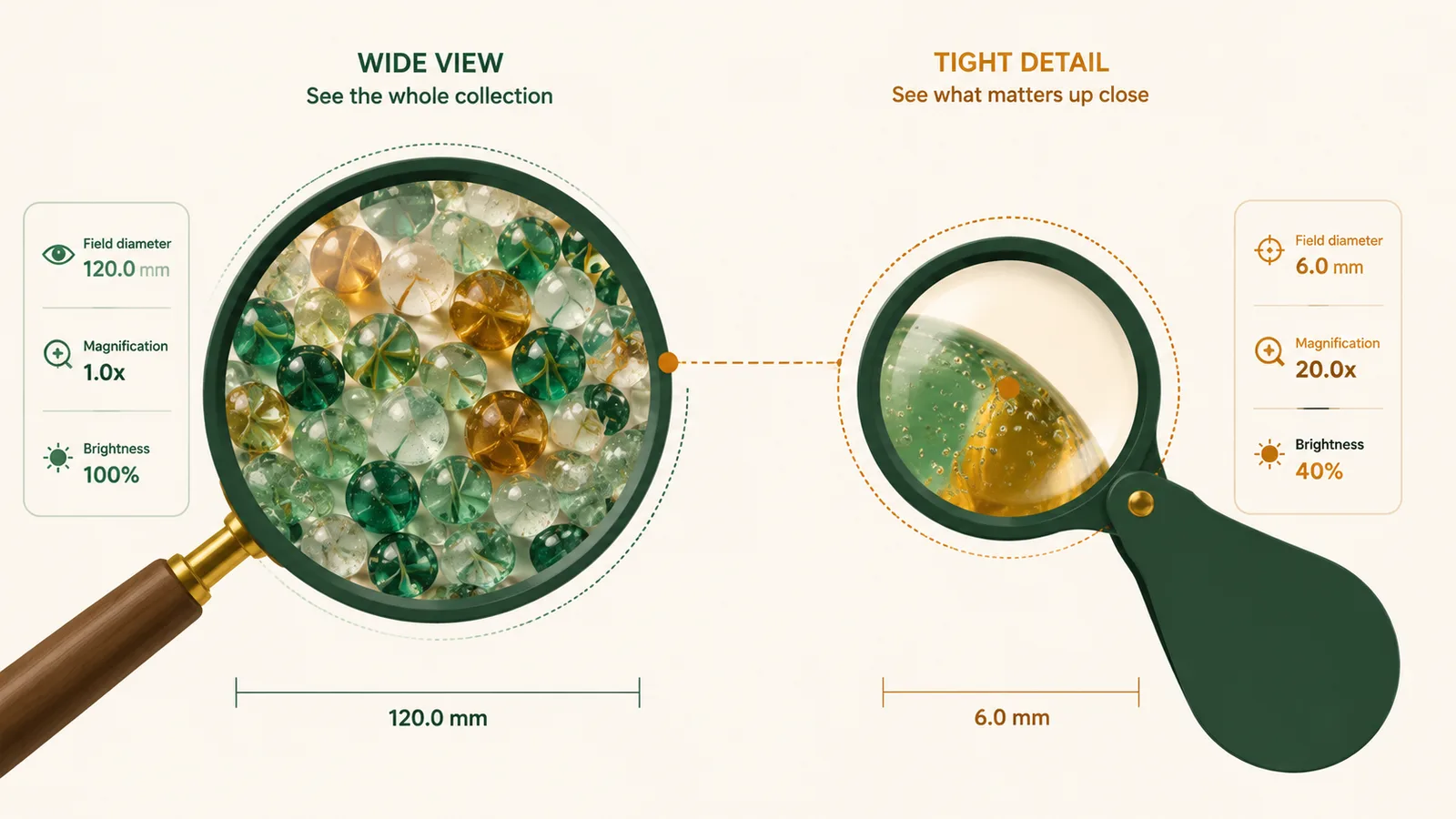
Where the Plain Hand Magnifier Wins
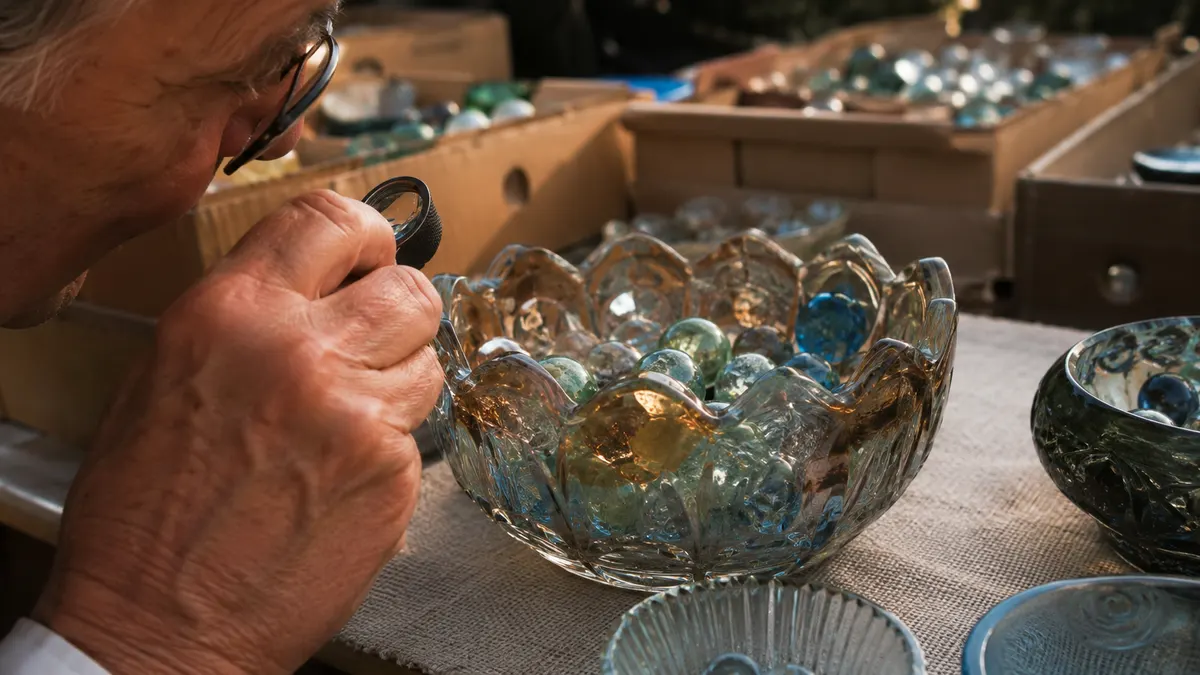
Now the side the loupe people would rather you not hear. A hand magnifier wins on the jobs where you want to see the whole piece and scan it quickly. A big hand-blown glass bowl, a manganese glass vase with a pattern running all the way around it, you do not want to inch around those with a loupe, fishing for a spot you do not even know is there yet. You want to hold the whole thing in view at once and move your eye over it. For that first pass over a large piece of glass, a broad hand magnifier is the right tool and the loupe is the wrong one.
It also wins on comfort. A hand magnifier at low power is easy on older eyes over long spells. You can sit and examine a shelf of glassware for an hour without the squint and the strain that 30x brings on after a few minutes. If you are a collector who mostly wants to enjoy your pieces, turn them in the sun, look at the patterns, and occasionally spot a chip, then a good hand magnifier may serve you better than a loupe ever will, and it costs a lot less to buy. It is the honest pick of the two for the person who is not grading every piece they own.
I will give you one exact trade that keeps me on the loupe side of the question. Last fall a young couple brought in a box of their grandfather's shooters, a mix of cat's-eyes and plain glass, nothing obviously wrong and nothing screaming collectible. I set a broad hand magnifier over the tray and everything read clean. Then I pulled my JARLINK off the bench and worked the 30x across the crown of the biggest piece. A bruise had grown a hairline up into the glass, the kind the gentle curve of a low-power lens just flattens away. I priced the lot honest, down on that one piece, and they were glad to know it before they sold it on to someone else. That is the whole argument in one afternoon.
Who Should Buy Which
Buy the jeweler's loupe if you grade, if you sell, or if you buy with an eye to resale. If you need to tell a chipped shooter from a mint one before money changes hands, if you sell marbles and glass at shows and have to price honestly in front of a customer, if you buy off tables and antique mall shelves where other people have already looked and walked past, then the loupe is the one that pays for itself on the first piece it saves you from overpaying for. That is the collector it is built for.
Buy the hand magnifier, or keep it, if your collecting is mostly pleasure and your pieces mostly well loved. If you enjoy setting a big piece of glass in the light and turning it for the beauty of it, if you seldom buy and almost never sell, then you do not need 30x of anything. A broad, low-power magnifier lets you enjoy the whole piece without the strain, and it is a gentler tool for a gentler kind of looking. Neither is better than the other. They are for different hands.
If you are still on the fence, this is what I tell people at the table: start with the loupe, because it is the one that reveals things you cannot see any other way, and it doubles as the tool that protects your money. It costs little, folds flat, and once you have seen a marble's interior under that light you will understand in a second what all the fuss is about. Then, if you find yourself squinting, add a plain hand magnifier for the long comfortable sessions. Two small tools, two different jobs, and most of the serious collectors I know end up with both.
Where the two split cleanly is the bench drill I run on every unknown piece. With the hand magnifier I can see the surface, fine. But to read the true nature of a marble I need the loupe jammed hard against my eye so both hands are free to roll it under the light without a third hand holding a handle. The difference shows up on a machine-made carrying a tiny imperfection where a handmade fleck would tell a different story. Nothing between the two changes what you are looking at; everything changes how well you can hold it still long enough to see it.
So the hand magnifier tends to live on the table for quick checks, and the loupe comes out when I actually mean to grade. For a dealer who spends Saturday hunched over a flat of entries, that is which one wins.
Carry the One That Protects Your Money
For less than most packs of good shooters, a folding 30x and 60x illuminated loupe goes in your pocket and stays ready for every table. This is the first tool I hand a new buyer.
Amazon Check Today's Price on Amazon →