
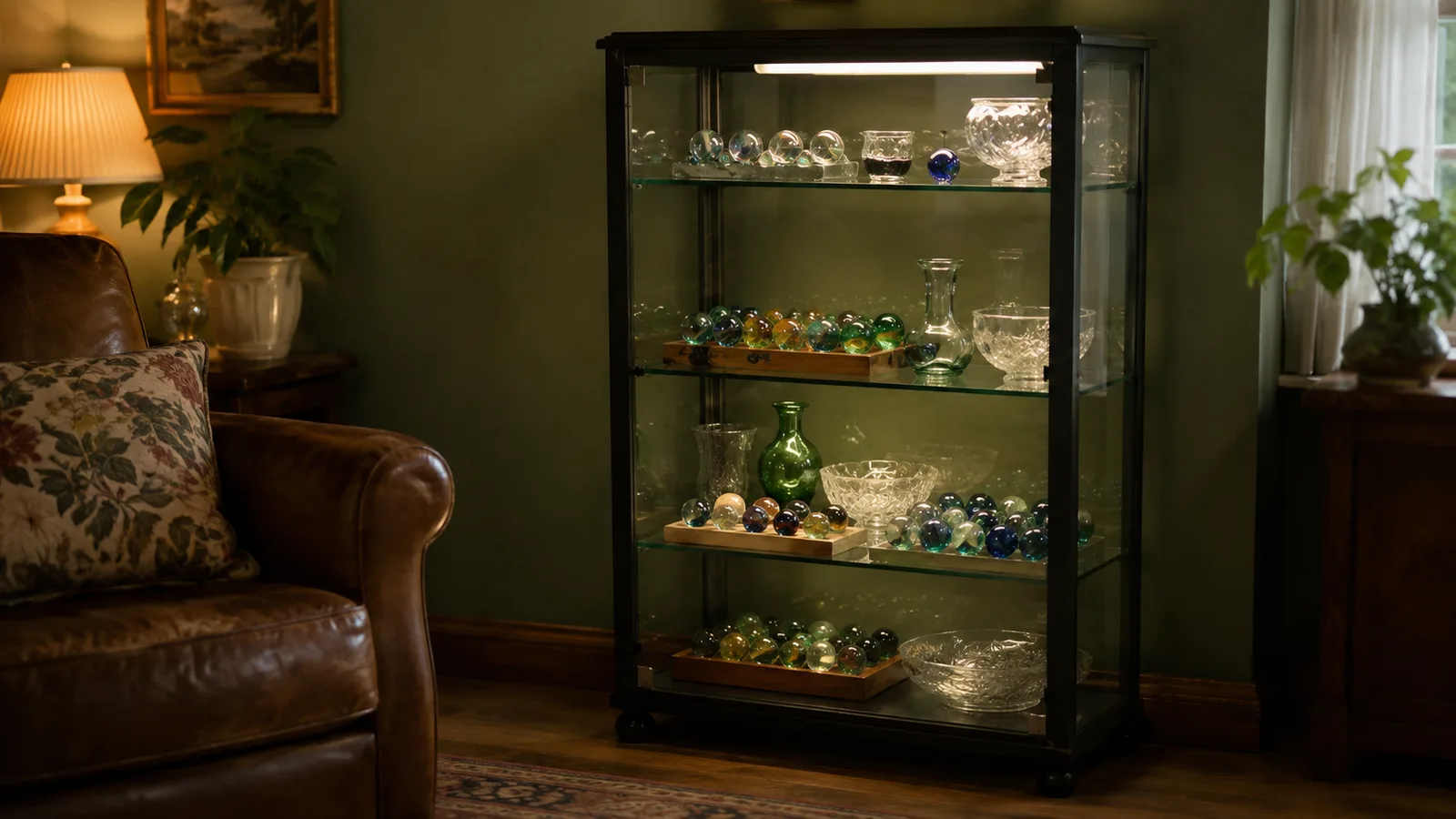
I have dusted the same windowsill collection twice a week for eight years now, Ruth and I, and every time I wipe a layer of gray off a marble that has not moved in a decade, I ask myself the same question. Is a shelf full of glass, sitting out in the open, really the right way to keep the pieces you mean to keep? So when the BROTTAR 4-tier glass display case showed up, I gave it a fair season with the good glass, the pieces we will not sell, to find out whether the protection actually earns its floor space and today's price.
Here is the honest one-line answer before all the detail. A glass display cabinet protects, and an open shelf shows. They are not rivals, they answer different questions, and most collectors need some of both. The cabinet is for the pieces you want safe from dust, sun, and every passing hand for years. The open shelf is for the pieces you actually reach for, the ones you hand to a visitor when they ask to see a swirl. The split below is how I decided which glass stays where, and what that decision actually costs somebody.
| Glass Display Cabinet | Open Shelf for Fragile Collectibles | |
|---|---|---|
| Cost to start | Costs real money up front, plus an afternoon to assemble | Nothing, you already own the shelf and the wall to mount it on |
| Dust | Doors shut, dust settles on the pane instead of on your pieces | Every piece grows its own film and each one is dusted by hand |
| Light and fading | Sits away from the window; internal LEDs light it only when you choose | Open to south sun that fades painted interiors and clouds glassware |
| Curious hands and pets | Glass doors keep fingers and paws off the glass | A reach away from every passing hand and every wagging tail |
| Falls and rolling | A closed unit keeps what is inside safely inside | One bumped corner clears a whole shelf of round marbles |
| Seeing the pieces | Lit and protected, but a pane to look through and to keep polished | Eye level and unglazed, the clearest view there is |
| Handling and rearranging | Open the door every time you want a piece in your hand | One reach, no door to lift, no knob to catch a sleeve |
| Assembly and footprint | Flat-pack build and a solid chunk of floor and wall | A board and a bracket, nothing to put together |
| Bulk capacity | Four fixed tiers, a modest armload per shelf | A long shelf holds a whole collection laid out flat |
| What can fail | Cheap LED strips flicker and a light aluminum frame wants respect | Overload it and the shelf itself becomes the hazard |
Read the table the way I do. The BROTTAR cabinet wins every row that is about keeping glass alive over the years, and the open shelf wins every row that is about enjoying it today. That is the real trade, not a glitzy one, and everything below follows from it. Neither is a mistake, they just solve different parts of the same problem, and knowing which part you actually have is the whole trick.
Where the Glass Cabinet Wins
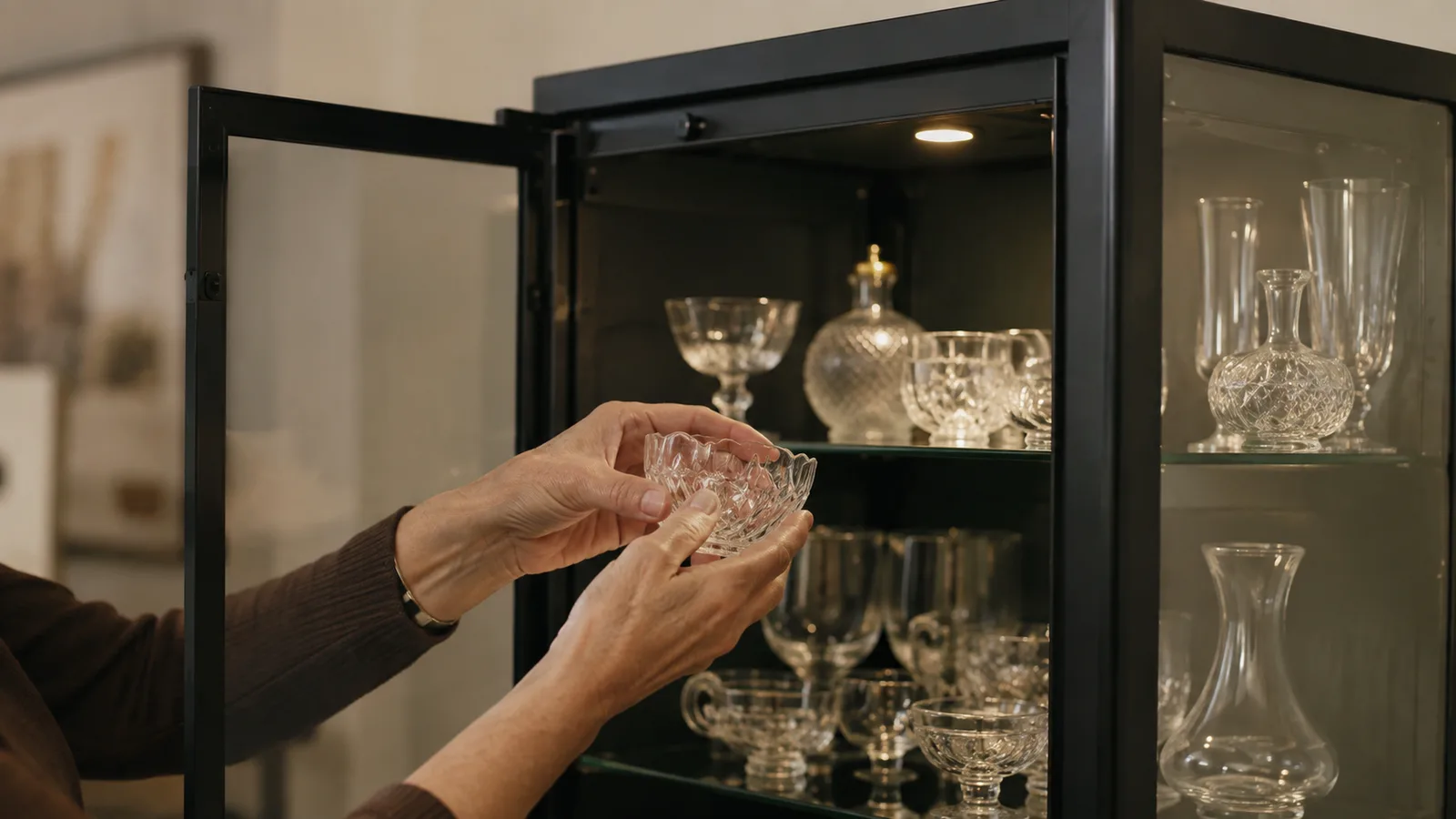
The first thing a closed cabinet fixes is dust, and that is not a small thing when you own fragile glass. An open shelf is a catcher. Every piece on it grows its own film, and dusting fragile glass is a hazard in itself, because every swipe of a cloth across a shelf is a swipe that can knock a round marble off the edge. Behind the doors, the dust settles on the pane where it belongs, and you wipe one piece of glass a week instead of forty marbles one at a time. For the pieces at the back that nobody touches, that is a real and measurable difference, and after a season with the cabinet I can say the marble in the far corner finally keeps its shine. The dust was the quiet thief all along, and the only reason I put up with it for so long is that it works slowly.
The second thing is light, and light damage is slower and easier to miss than dust. Certain marbles carry painted or lacquered interiors that fade, and a treasured piece of glassware will cloud after years in a south window. A cabinet you can place away from the sun, and this one lets you light it on your own terms. It carries three color LEDs and a motion sensor that wakes the light when you walk near, which is pleasant for showing. But I keep the LEDs low and mostly off, because light of any kind, even a cool LED, works on color over a decade. The honest point is that you get to choose where the case sits and when it is lit, and that choice is the whole difference between a display and a faded shelf in the sun.
There is a third win I did not expect, and it has to do with the weight of the pieces. An open shelf carries a row of heavy glassware the same way it carries a row of light marbles, which means the whole load presses down across the one board. The cabinet spreads everything across four tiers, so the heavy bottoms go low and the light pieces go high, and no single shelf ever carries more than it should. For anything with a thick pressed base or a full bottle of older glass, that distribution is a real safety win rather than a cosmetic one.
Shut Out the Dust and Sun That Weather Your Best Glass
A glass-fronted cabinet set away from the window, lit low and on your terms, is the difference between keeping a piece and just storing it in the sun. The BROTTAR 4-tier is the one that earned its corner in my shop after a season of honest use.
Amazon Check Today's Price on Amazon →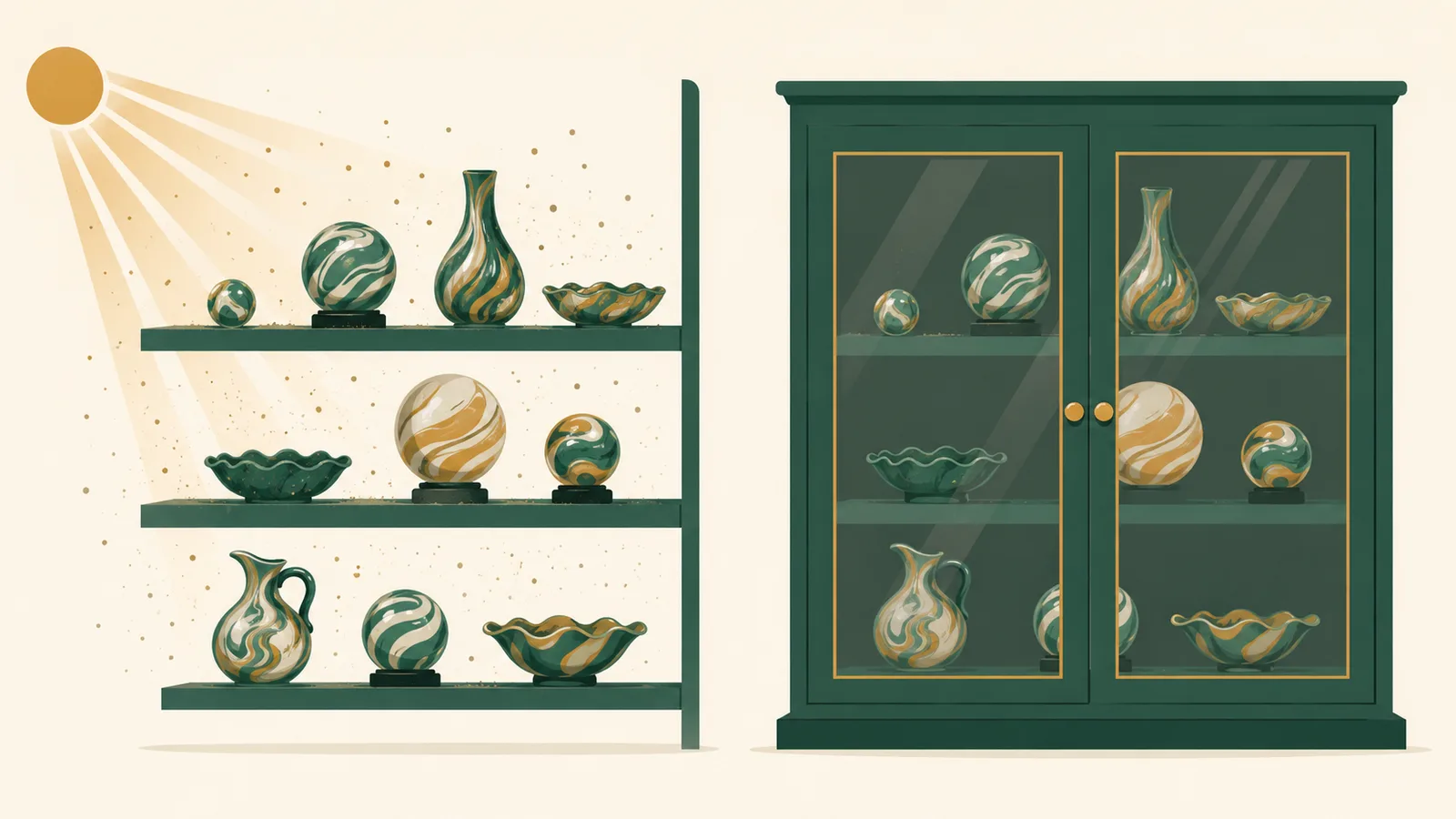
Where the Open Shelf Wins
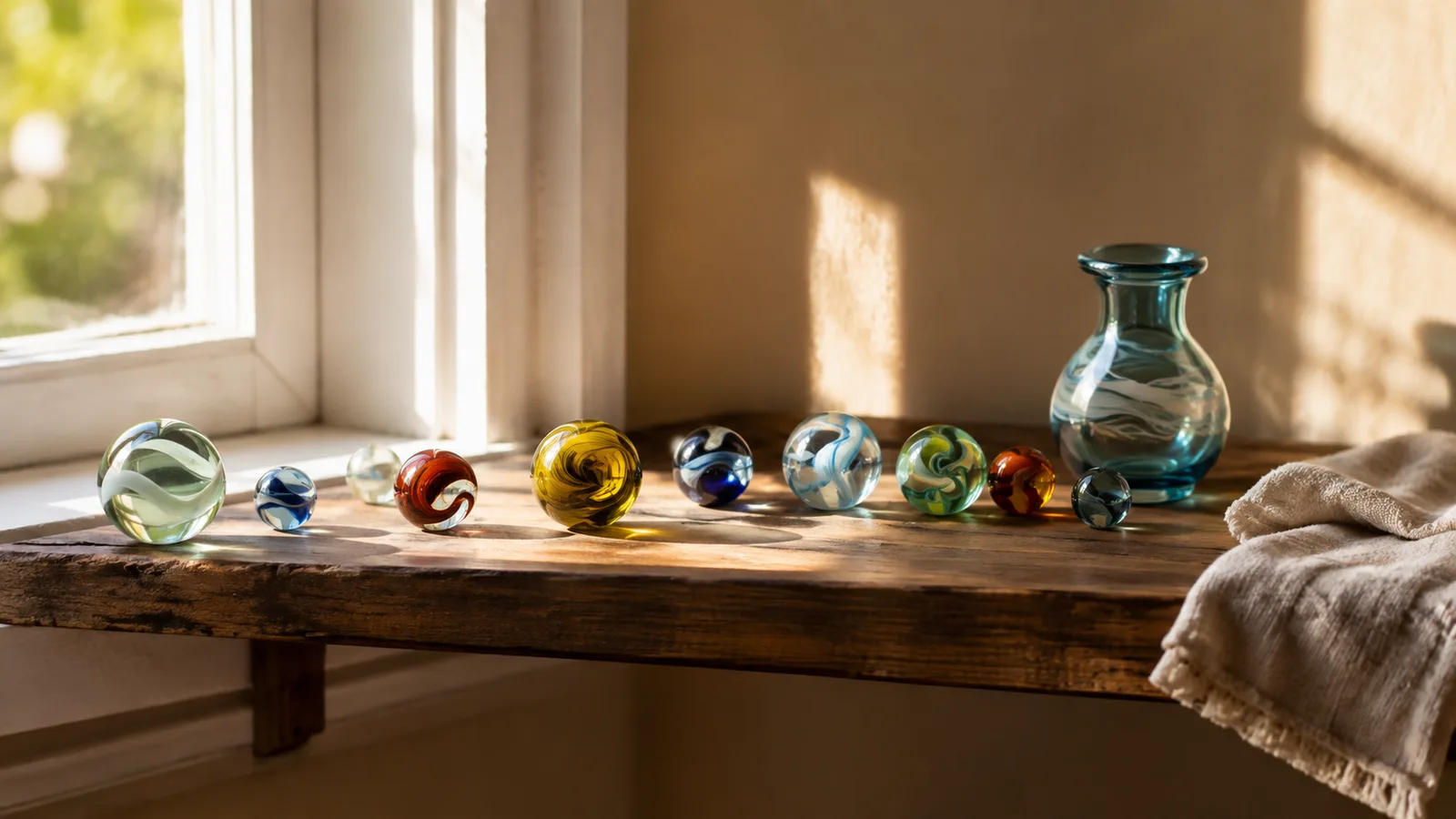
Now the honest half I have to give the open shelf, and it is a real half. An open shelf shows, and showing is not nothing. Behind glass you look at a piece through a pane that glares and that you polish as often as you actually look at it. An open shelf is the clearest view in the house, eye level, unglazed, no barrier between the glass and the person telling you how fine it is. And a collection that is never touched stops being a hobby and becomes a display only. I handle my glass. I turn a swirlie to the light, I hand a piece to a customer. Every one of those pickups is cheaper and more natural on an open shelf than behind a door.
It also costs nothing and takes no floor, and for the bulk of a real collection that wins the argument outright. If you have a few hundred pieces, especially ones you are still sorting or that are mostly trade stock, an open shelf or a good divided box holds more with less work and less money. And I will be honest, a budget cabinet can let you down in ways a shelf never does. This BROTTAR carries a light aluminum frame I would not trust with heavy glassware on the top shelf, and the spacing between tiers is modest, so a tall vase rubs the glass above it. The panels polish up fine but they fingerprint, and in a house with pets the case shows smudges faster than the pieces it is meant to protect. Neither failing is fatal, but both are real, and both are the kind of thing you only learn by living with one.
The open shelf also wins on the simple matter of range. A cabinet is four tiers high and a fixed footprint, so what does not fit on those four shelves has nowhere to go. A wall of open shelving keeps growing with the collection, and for a dealer who accumulates as fast as he sells, that open-ended capacity is the difference between a tidy case and a box of overflow in the back room. I would be lying if I said the extra capacity did not matter to me, because it does, every single week.
For the pieces nobody touches, the cabinet wipes one pane instead of forty marbles. For the pieces I reach for every day, the open shelf does not make me lift a door.
One more owner's note about the BROTTAR's doors, and it is the reason I trust the cabinet with the pieces I would not risk on a shelf. Glass, unlike most things, does not get more beautiful the more it is handled; it gets a chip, a haze, a rounded edge from being knocked against its neighbor. Behind a door that is almost always shut, my best marbles sit the way I set them, month after month, untouched, so they stay near-mint instead of slowly becoming honest playthings. For anyone who resells, that is the single most concrete thing the case buys. A near-mint piece is worth a story; a played one is worth a fraction.
And I should say the obvious thing the marketing leaves out, which is that an open shelf shows more of the collection at once. Four tiers of a cabinet hold a fraction of what a long wall of shelving holds, so if the goal is to see everything you own in one sweep, the shelf wins without argument. The cabinet is a smaller, curatorial statement, not an inventory. There is nothing wrong with that, it is simply a different ambition, and honest the moment you know it.
Who Should Buy Which
Buy the cabinet when protection is the whole point. A fragile collection you have finished arranging, pieces you mean to keep and keep safe for years, a corner you want lit and shut against dust and curious hands, that is the honest case for it. It is also the right call if children or pets live near your glass, or if you show pieces where the good glass should not sit within reach. And for fragile standing glassware that tips on an open shelf, the closed case is the difference between a keepsake and a swept-up pile of shards.
Keep to the open shelf if you handle your glass constantly or you are still sorting. And skip the cabinet as a storage box entirely, because if the doors are never open and the lights never on, you have spent real money and an afternoon of assembly to make a dustier, harder-to-reach shelf. Do your bulk in a box or on a plain shelf, keep your show pieces close, and let each system do what it is good at rather than forcing one to do everything. The cabinet is not a second closet; it is a stage, and it only earns its keep when the good pieces are on it.
If I had to put my whole shop on one rule it would be this: decide what each piece is for before you choose where it lives. A marble you turn in the light every evening is a daily piece and it belongs where you can grab it. A stemmed vase you dust once a month and otherwise leave alone is a keeper and it belongs behind glass. The mistake is treating every piece the same way, because a collection is rarely all one kind of thing. Mine certainly is not, and I suspect yours is not either.
The season with the BROTTAR taught me one more thing worth keeping. Neither approach is better in the abstract; each is better at a job. The cabinet is better at the long game, keeping color and edges and a clean shine on the pieces that should outlast me. The open shelf is better at the daily game, the handling and the looking that keep me a collector instead of a storage room. I do not think of it as a choice so much as a rotation, and it has made me far more deliberate about which piece is where and why.
Most collectors, and I include my own shop, land in the middle, and that is the healthy place to be. One cabinet for the twenty pieces that matter, lit and shut, and open shelves or drawers for the daily churn. The BROTTAR cabinet I keep stands against the far wall, away from the window, holding the glassware and my best swirlies. The windowsill still carries the pieces I move and touch every week, because seeing them is half the hobby and I am not going to hide that from myself just to feel tidy. Both systems earn their place, and the collection is better off for having a home for each kind of piece.
Give the Pieces You Mean to Keep a Wall of Their Own
One glass-fronted cabinet, set away from the window, is enough to hold the good glass and shut out the dust, the sun, and the curious. The BROTTAR 4-tier is the unit that earned its corner in my shop after a full season of honest use.
Amazon Check Today's Price on Amazon →