

Every box lot of bulk marbles arrives the same way: everything mixed, and the little stuff hiding the good pieces. This spring a single tote from an estate auction held seven shades of green, three of cobalt, a pile of cream cat's eyes no bigger than my thumbnail, and enough big shooters to roll right over the small ones. If you've ever tipped a fresh lot onto the bench to sort it, you already know the feeling. Nothing stays where you set it, the good pieces slide to the bottom of the pile, and inside an hour you are re-fishing the same swirl you already picked out twice. It is the untidiest part of a tidy hobby.
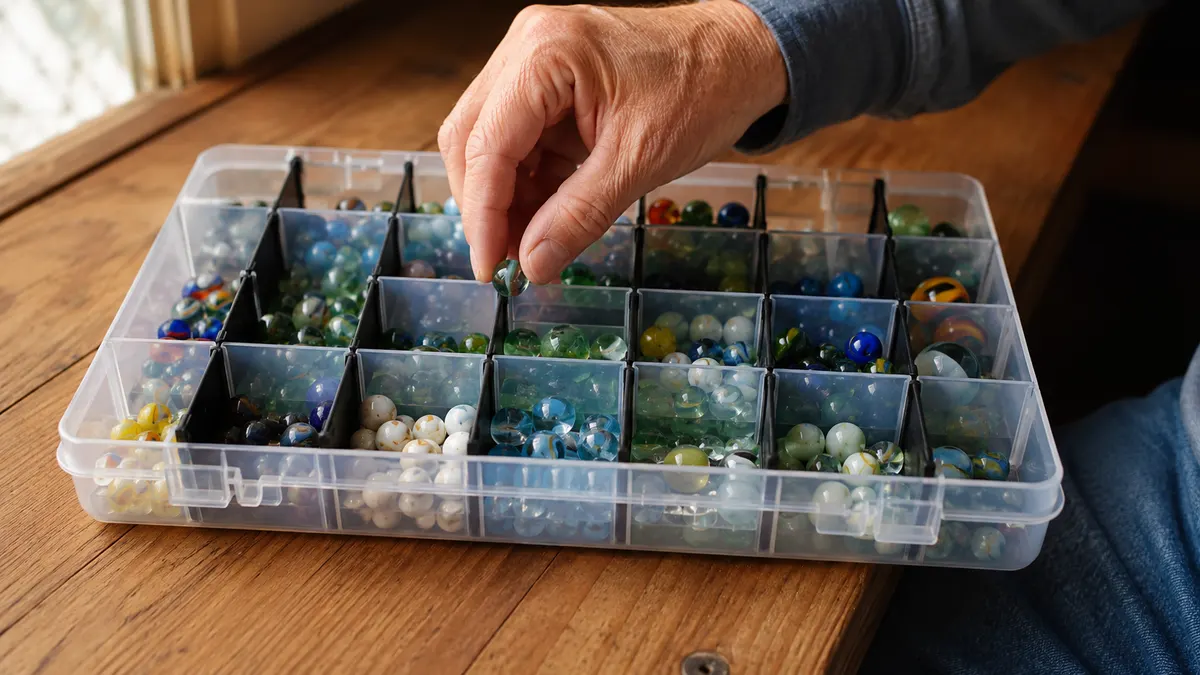
For years I sorted lots into whatever bowls and tins were within reach, and I nearly always had to re-sort part of it the next day. So when Ruth brought home a clear plastic box with a grid of adjustable dividers, it read like the obvious answer. It's a DUOFIRE organizer, 34 compartments, the dividers slide so you can size a cell to fit different marbles, and it costs very little at today's price. The honest version is this: it genuinely helps. It also does a few things I only noticed after weeks of daily use, and those are exactly the things the product photos leave out. That is what I want to tell you here, plainly.
The Quick Verdict
A genuinely useful sorting box for small and medium marbles, with dividers that shift more than the photos suggest and a cover that isn't really a lid. Buy it knowing it suits the little stuff best and needs a careful hand.
Amazon Check Today's Price →Don't let the good pieces stay buried at the bottom of a tote
The adjustable grid sorts a bulk lot by size and color in one pass, and keeps each marble where you set it while you work. Straightforward, clear plastic, and cheap enough to buy two.
Amazon Check Today's Price on Amazon →How I've Used It
My bench top runs about four feet across, and I cleared a strip at the end for this DUOFIRE before I ever opened a fresh lot with it. Day one I set the dividers up in a pattern I still use: a column of small cells along the left for the little cat's eyes, wider cells down the middle for standard shooters, and the biggest cells I could manage along the right edge for the heavy pieces. Then I started dropping marbles in from the estate tote, one at a time, by size and then by color.
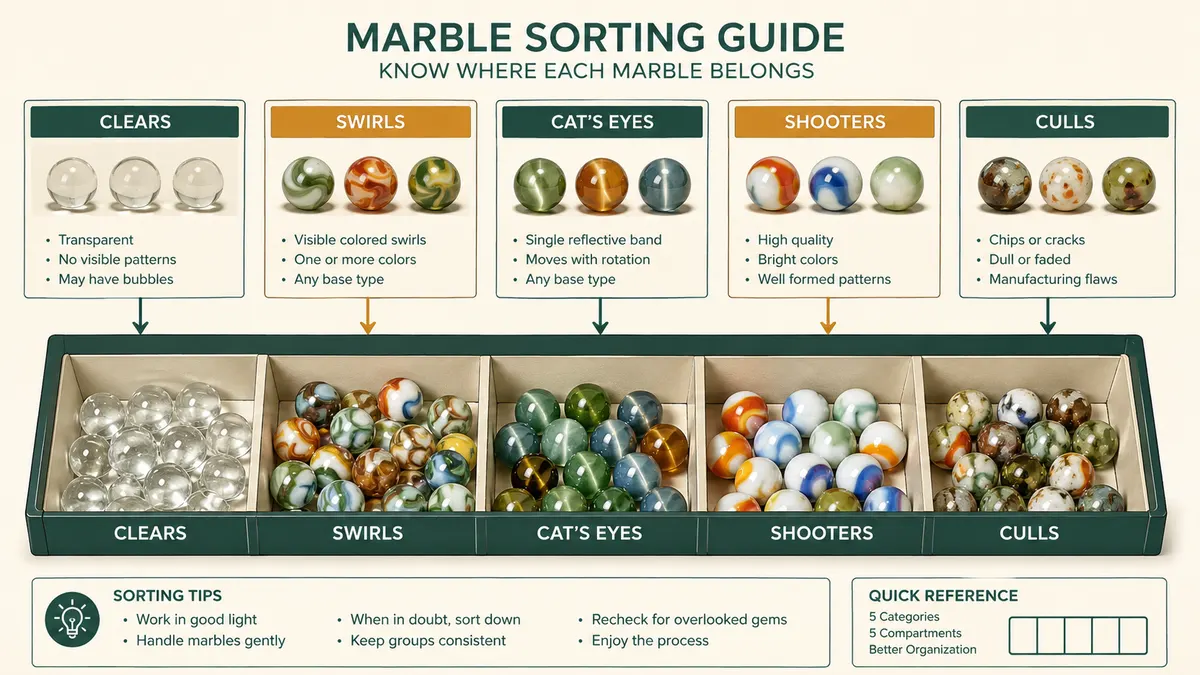
The first afternoon went well. Working through maybe nine hundred marbles, I had everything off the bench and into the box in one sitting, and for the first time I could see exactly what the lot was worth at a glance. The clears got a cell, the swirls got another, the solid colors lined up in their own row, and the broken and chipped pieces got a cell of their own so I could cull them out instead of meeting them again on the next re-sort. Compared to the loose tote I was using before, that alone was a real step up.
I keep the box on the shop bench, not in the display cabinet and never in a window. Clear plastic and direct sun are a bad pairing, the UV yellows the tray over time and it fades the glass, so it stays in the shade. When the bench is full I lift the whole thing to a shelf, and that is when I started to learn its limits. You learn a tool's habits fast when you move it every day.
The Dividers: More Flexible in Theory Than in Practice
The selling point is the adjustable grid, and it's mostly true. The dividers are plastic tabs that sit in a molded channel, so you can widen a cell or narrow it to suit what you're sorting, and for the first week that felt great. You can make a hopper for cat's eyes and a flat row for shooters in the same tray. But here's what nobody puts in the review: the tabs do not lock. They rest against the channel, they are not clicked into place, and once a cell is full of heavy shooters they will slip under the weight and under the pressure of your fingers.
I have had a divider fold over mid-sort while I was reaching across the bench, and in the time it took me to notice, two cells quietly poured back into one another. It is not a simple failure that ruins the box, just something to plan around. I stopped making the two end cells oversized and left them half full, so no divider was taking the weight of two loaded sides at once. That settled it, and I have not lost a cell since.
Plan the layout so no divider carries the weight of two loaded cells at the same time, and the grid holds its shape fine all day. It is a quirk of the plastic, not a broken part, and once you understand it the box behaves. What it means for real work is that you set your layout once and then leave it alone rather than rebuilding it every session.
What Falls Through: The Size Problem
The word 34-grid undersells how small some of those compartments are. A standard shooter, say half to five-eighths of an inch, sits fine in a small cell with a little room to spare. The big ones, three-quarter-inch and up, do not fit the small cells at all, so you end up leaving a few cells empty simply to give the heavy pieces room to lie flat. The box is really built for the little and medium stuff, which is most of bulk, but it will not hold your prize shooters comfortably.
Smaller still is the real gap. Tiny cat's eyes sit low in their cell, barely above the bottom, and the moment you reach in to pick one out, your fingertip presses two or three neighbors up and over the edge. Nothing in the grid stops a marble that wants to roll, and because the tray is shallow, a quick nudge at the bench sends one scooting right off the side. I keep mine on a level, non-sloped part of the bench and I hold both edges whenever I carry it, because this is a tray you move flat, not a handled box.
The Box Itself: Plastic, Light, and the Glass Question
The plastic is thin and clear, which is fine for sorting, but it will not survive a drop once it is loaded with glass, and it scratches if you rest a tool on it. Those little hairlines bug me, not because they hurt function but because a scratched tray reads as carelessness when a customer is looking around the shop. I fold a soft cloth under it and I never stack anything on top. It wants a gentle home on a stable surface, and that is honestly fine for what it is. The DUOFIRE is not built to be thrown in a crate, and I would not pretend otherwise.
The bigger honest point is the cover, or the lack of a real one. Some versions of this organizer come with a lid that snaps on, and the listing makes it look like it seals. In practice the fit is loose, it's more of a dust cover than a seal, and it does nothing to stop a marble that has ridden up over the top of a cell. So treat it as a tray you can cover, not a case you can tip over and trust, and plan your handling around that.
What the Photo Doesn't Show
The marketing photo shows a tidy grid packing every compartment edge to edge. Real life has empty cells, because you do not have thirty-four distinct kinds of marble in one box. In my usual setup I use ten or twelve cells and leave the rest for overflow, and I built my own labels on a strip of masking tape along the front edge. It works, but it is not as neat as the ad, and the empty cells are where the loose bits end up if you are not careful.
And there is no instruction for what goes where. That part is your job, and it takes one sort to work out a layout that actually holds. Do the first lot as a template, note what fits where, then rebuild the same grid for the next lot and it becomes fast. Budget the first hour as setup rather than sorting, because a grid you set once and trust beats a grid you adjust every ten minutes.
How It Holds Up Over a Season
After a few months of near-daily sorting, the honest report is that the plastic has held up better than I feared. No cracked corners, no snapped divider, the channels as straight as the day it arrived. The things that have worn are the things that wear everywhere: the clear surface shows fine hairlines where my thumbs have worked the same cells, and the edges are a little dulled from being set down hard a handful of times. Neither affects how it sorts, only how it looks up close, and I keep it this side of the cabinet for exactly that reason. This DUOFIRE has earned a place on the bench, which is more than I can say for the last two tubs it replaced.
What has not changed is the divider behavior. It still does not lock, and it never will, because it was built to sit in a channel and nothing more. Knowing that from the start is the whole difference between being annoyed daily and being fine with it. I have also learned which cells to keep half empty and which can take a full load, and that knowledge is now the real tool, the plastic just holds it.
If you are deciding between this and a pricier divided case, the honest word is that the cheap tray does the everyday job, and the more expensive case is only worth it if you need it to travel or to stack. For a bench that does not move, spend the little money and keep the difference for a good marble.
There's No Glue in It: What Actually Holds
This piece is titled grids, glue, and what falls through, and here is the honest take: there is no glue in this box, and nothing to hold a marble or a divider in place but fit and friction. Everything stays put because of how the plastic sits and how the cells press, not because of any adhesive, clip, or latch. That is the real thing to understand before you buy. A tray that depends on friction needs a steady surface, a hand that does not bump, and a layout designed so nothing presses sideways.
Once I stopped asking the box to do more than it does, I stopped being annoyed by it. I stopped overfilling cells, I stopped trying to make the lid a seal, and I started carrying it flat with both hands. The glue, such as it is, is the friction of a sensible layout and the habit of not knocking the bench. That is about as plain as I can put it, and it is the whole secret to being happy with this kind of organizer.

Alternatives I Considered
For pure storage this box beats the loose tote I used to keep, and it beats the collection of old jars and tins rattling on the shelf. I reach for it every day for the sort-and-resell work. But I still keep a set of clear acrylic display stands for the pieces worth showing, because a sorting tray is not a display, and the glass cabinet holds the good stuff where light and customers can see it. Different tools, different jobs.
If you are mostly sorting to sell small and medium lots by the pound, this tray earns its keep. If you mostly want to show off your best dozen pieces, the tray is not your tool at all. The honest division is that storage and display are separate jobs in this hobby, and this box is squarely on the storage side of the line.
What I Liked
- Adjustable cells let you size a compartment to fit the marbles you actually have
- Clear plastic means you can read the sort at a glance, no opening forgotten lids
- Sits flat in a drawer or on the bench and costs little enough to buy two
- Easy on small and medium marbles, which is what most bulk lots are made of
- Empty cells give you a ready home for odd sizes, culls, and whatever rolls loose
Where It Falls Short
- The dividers are free-moving tabs that slip under the weight of a full heavy cell
- No true seal; the cover is loose and a tipped loaded box is a real mess
- Thin plastic scratches and will not take a drop once it is full of glass
- Big shooters do not fit the small cells, so you burn space to give them room
- Tiny marbles sit low and are hard to pick out without nudging neighbors over
A two-thousand-piece lot sorted in one afternoon, then a single heavy shooter that let a divider slip and sent a whole cell of cat's eyes mixing back the way they came.
Who This Is For
If you buy bulk lots and want them organized enough to know what you own, or you price small and medium lots for resale, or you simply want the bench sorted by size and color without a mountain of jars, this box earns its place. It is cheap and clear, and once you settle on a layout it makes quick work of any mixed lot that comes through the door.
I would put it plainly: it is the right tool for the bulk end of the hobby. If that is the work you do, it will save you time on every single sort and keep your fingers out of the same pile twice. For that job there is nothing simpler that does it as well.
Who Should Skip It
If your collection is mostly big shooters, if the box is going to travel or get stacked and jostled, or if what you really want is to show marbles behind glass rather than store them, pass. And if you need sealed, airtight, stackable storage, look elsewhere. This is a bench tray with a loose cover, not a vault, and it is happiest holding still on a level surface. Bought for what it is, it serves well; bought expecting a sealed case, it will disappoint.
Give a tumbling lot a home it won't roll out of
Sort by size and color in one pass, keep the good pieces easy to find, and leave the display stands to the pieces worth showing. A small, plain fix for the messiest part of the hobby.
Amazon Check Today's Price on Amazon →