
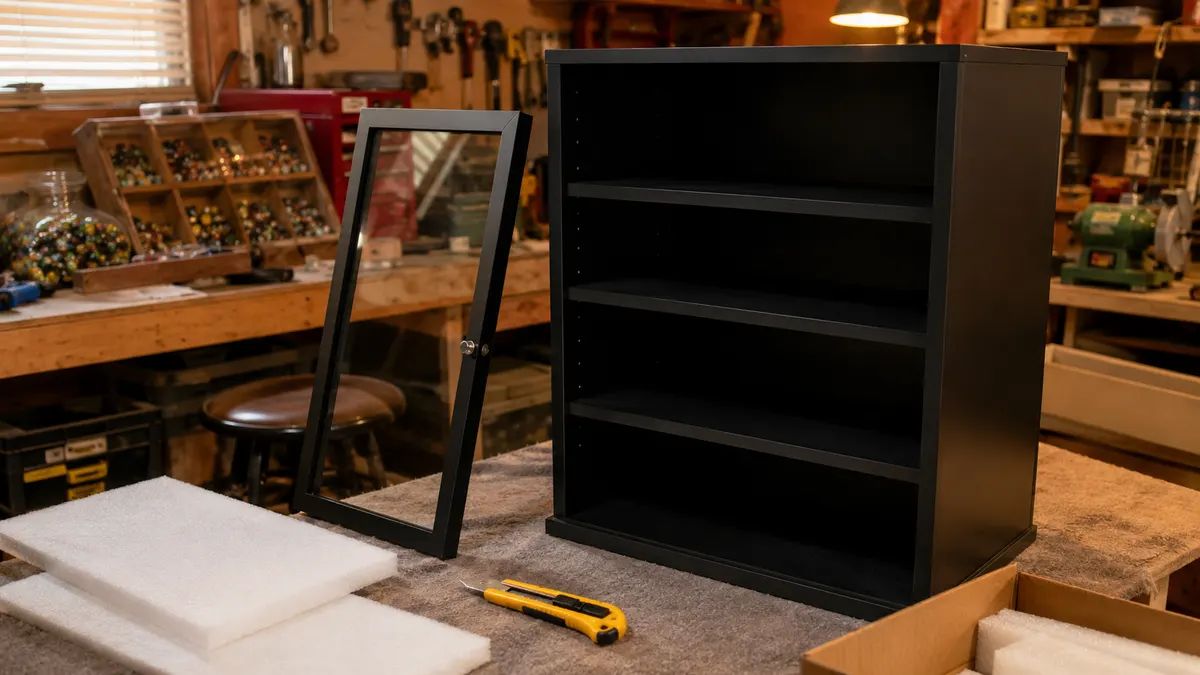
The product photos make a glass display cabinet look like it arrives already glowing, with your collection neatly lit and dust-free inside a door you never have to fight. Nobody photographs the part where you spend an afternoon on your knees with an Allen wrench, or where you discover the shelf rating printed in letters small enough that you squint to read them. I have had the four-tier BROTTAR in my shop for a while, and this is the honest side of it. The parts that work, the parts that do not, and what you should know before you clear a corner and a credit card for it.
The Quick Verdict
A genuinely useful glass-fronted cabinet once it is together, if you go in knowing the assembly is fiddly and the lights are more for show than for grading. The doors and the weight limits are what earn it, not the glow.
Amazon Check Today's Price →A real set of glass doors for the price of a weekend
The BROTTAR holds your fragile pieces closed, dusted off, and out of the reach of an elbow. Just budget an afternoon to build it. Check the current price against your corner and your patience.
Amazon Check Today's Price on Amazon →How I've Used It
I do not buy display furniture to photograph it. I bought this to hold the part of the collection that keeps getting moved around when I sort a marble pickup or take stock of the glassware before a show. Since it landed, it has held a couple thousand marbles in small trays, a handful of Fenton pieces, some cut glass, and more than a few awkward vases I had nowhere else to put. Every piece has been handled, shifted, taken out for a buyer, and set back in. That is the test that matters to me, a dealer who never quite trusts nice furniture to stay nice after real use.
To be fair about how it got there, the box is heavy and the doors do not come pre-hung. I cleared a Saturday morning and it took me most of it. Do not let anyone tell you it is a ten-minute job, because it is not, and I will walk you through why it is slow before I tell you what you get for the time. The payoff is a real cabinet with real glass on four sides, and I want nobody to be surprised halfway through the afternoon when it is still not standing.
Assembly: The Part the Photos Skip
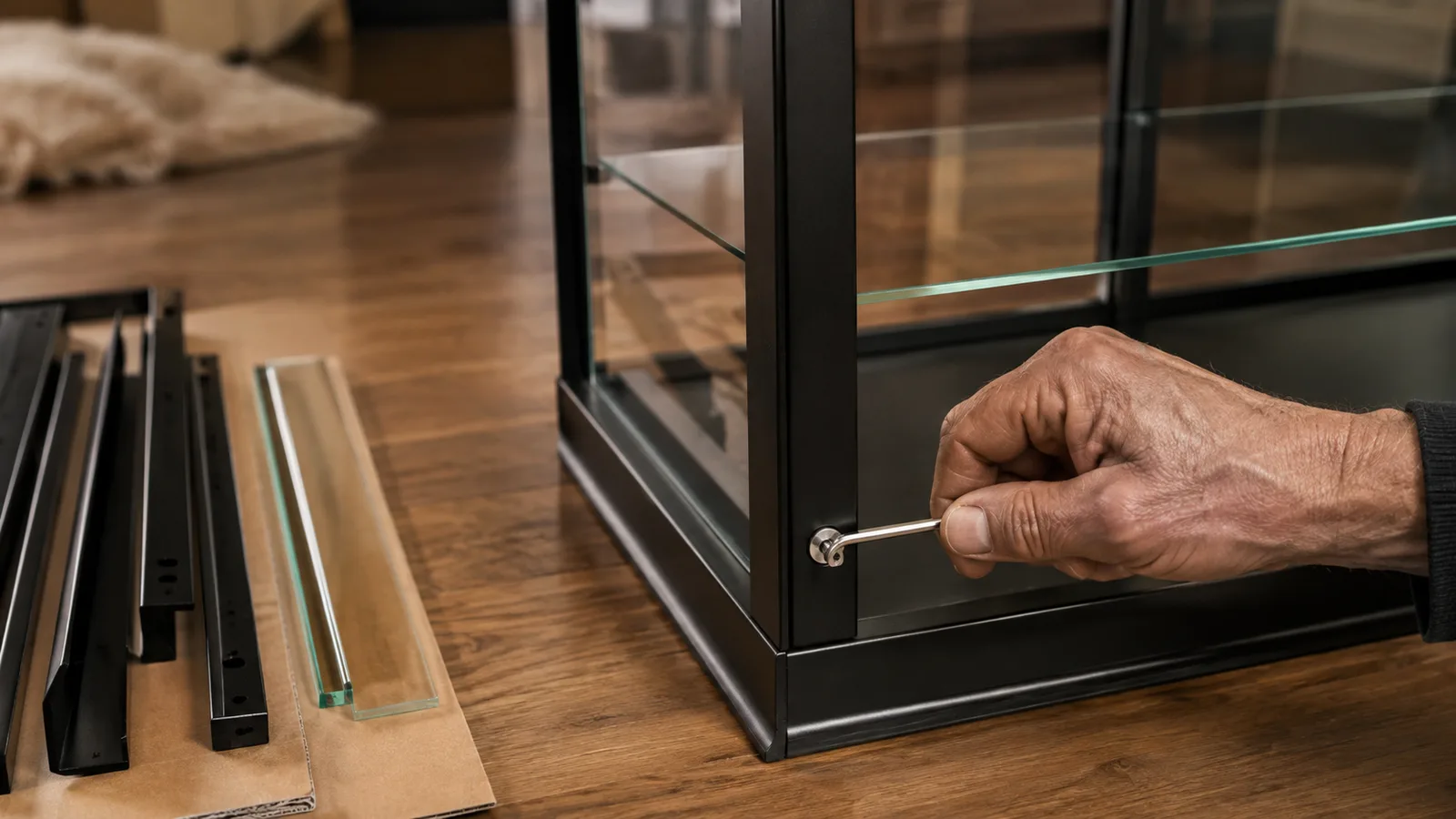
The cabinet ships flat, which is the only reason it is shippable at the price it sells for. That means you build it. The frame goes together with cam locks and dowels, and the side panels are real glass, which is the good news and the bad news all at once. Good, because the sides being glass is what lets the light through and makes the whole thing look like a proper curio case from every angle. Bad, because a real glass panel is heavy and unforgiving, and one drop turns your new cabinet project into a call to the glass shop before the rest of it is even up.
My honest advice on the build is to work on carpet or over the cardboard it ships in, not on a hard floor, and to have a second person for the step where the glass goes in. I did it solo and it is doable, but there was a moment with the top panel where a helper would have been a small mercy. The cam locks need to be tight or the cabinet rocks a little on its feet, and getting them snug takes a fair amount of turning. If you are not mechanical, budget the full afternoon. If you are, still budget the morning, because there are more parts than you expect when the lid comes off.
The glass doors are the fiddly bit. They hang on hinges that need their screws started straight, and a door that is off by a hair on one hinge will not close flush. I had to loosen, shim mentally, and retighten one door twice before it sat right. Once it is square, the doors close well and there is no visible gap around the latch. But you will tighten more screws putting this together than you expect, and you will do it kneeling. For a man whose back has seen better decades, that part does not get easier.
There is one thing worth slowing down for during the build, and that is the level on the feet. The cabinet will not sit right on an uneven floor unless you take a few minutes with the little adjustable feet at the base. If I had not done that, the doors would have dragged on the frame no matter how square I got the hinges. It is a twenty-minute fine-tune that nobody mentions, and it is the difference between a cabinet you are pleased with and one you nudge out of habit every time you walk past it.
The Lights: Good Glow, Not for Grading
The headline feature is the lighting. There are color lights and a human-body sensor that turns them on when you walk close, off when you walk away. The genie-lamp colors look strong in the marketing. In the room, the warm white and amber settings are the ones I actually use. They make the glass and the marble colors come up nicely and they are easy on the eyes at the end of the day. The more saturated color modes are a party trick. They are fun for ten minutes and then they stop being useful for looking at the actual pieces.
Here is the honest limit. These are strip lights, not true display lighting you would use to inspect a piece. They throw even light onto whatever is near the front of the shelf and they do a fine job of showing a collection. But if you are trying to grade a marble, check a seam, or read a maker mark in a piece of glass, this is not the light for it. It will not replace a lamp you can move or a loupe held in your hand. Treat the lights as ambient beauty, not work light, and you will not be disappointed. People who expect them to be appraisal lights are the ones who write the one-star reviews.
The body sensor is a genuine convenience and also has a quirk worth knowing. It means you do not fumble for a switch, which I like. But it also means the lights fire whenever you walk past, even mid-conversation, and they cut out a moment after you step away. If you have a piece you want lit up all day long, you will want to know how the switch works before you rely on it, because the sensor is the default. It is a minor thing, but it surprises people, and a surprised collector is a frustrated collector.
Loading: The Weight Truth Nobody Prints
This is where I talk about weight, and it is the part that matters most if you are a collector and not just someone decorating a living room. The shelf rating is printed small on the underside, and it is lower than you hope. You cannot stack a wine-cellar worth of glass on four tiers. You can hold a reasonable collection of marbles, small vases, and moderate glassware, spaced out so nothing leans on anything else. That is the honest reality of something this slim and this affordable.
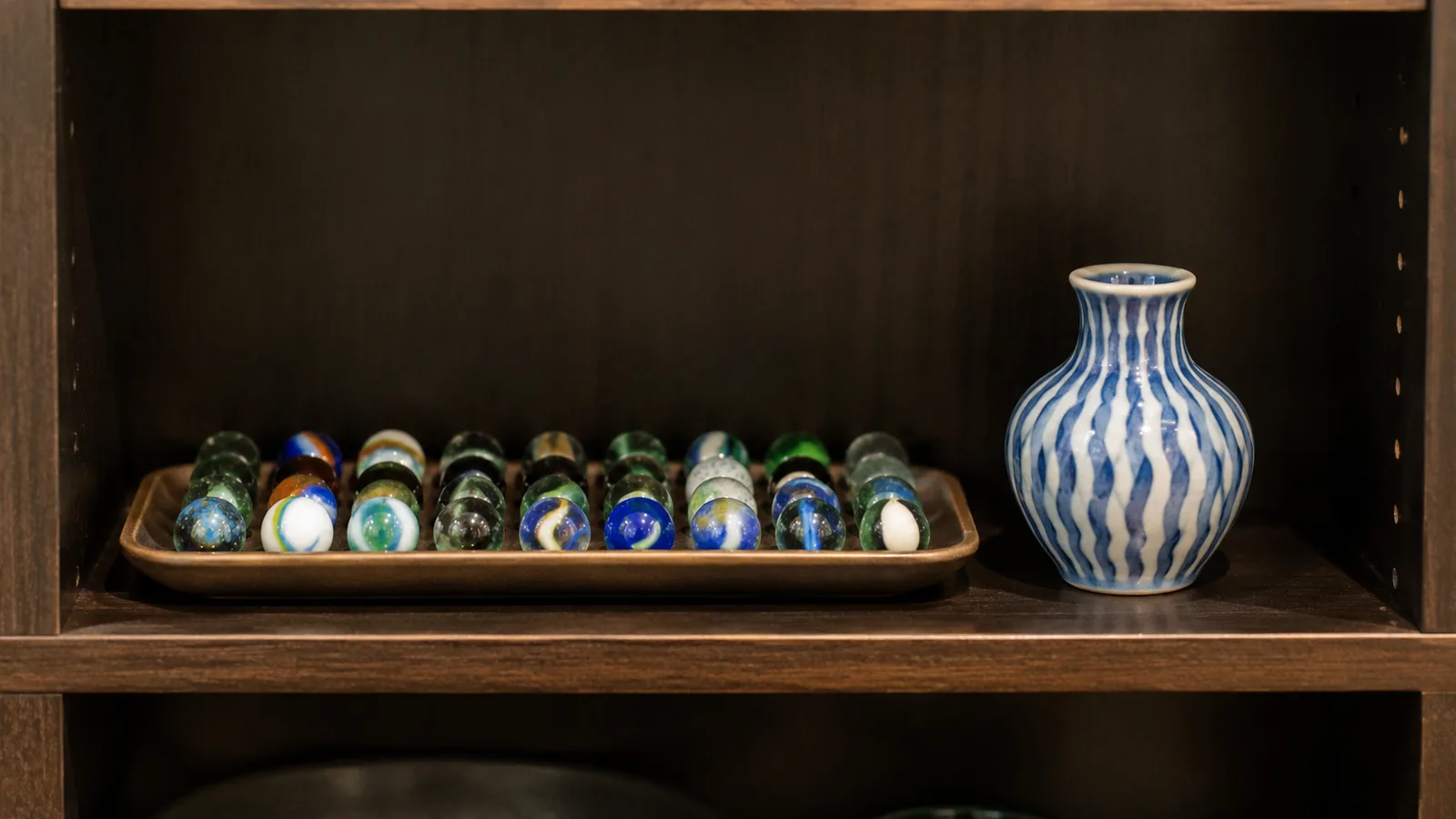
My approach is to treat each shelf as a one-layer display, not a storage closet. Marbles in small trays or shallow dishes sit easily, and a tray of a couple hundred shoots is nothing for these shelves. A Fenton bowl and a couple of vases per shelf is comfortable. The moment you start stacking, or you crowd pieces so they touch, you are above what the shelf is honestly meant to carry and you are asking the glass floor to do more than its share. I learned this the day I overfilled one shelf with cut glass and heard the shelf creak a little under the load. I cleared half of it and it has been fine since. But the creak told me the printed number was real, and I have respected it since.
The cabinet is also genuinely top-heavy when it is empty, because the frame is light and the glass is all above the low feet. When it is fully loaded it stays put nicely. Before it is loaded, or if you load it heavy near the top and light near the floor, you want it against a wall and you want those feet level or it will rock. I do not say that to scare you. It is a real consideration for anyone putting heavy glass up high on glass shelves, and it is the kind of detail a dealer notices because he has stood too close to a whole shelf going over.
What I Liked
- Real glass side panels let the light through and give it a true curio feel from every angle
- Doors close flush and keep dust off the pieces, so you are not wiping glass rims and chipping them
- Warm, amber, and white light options are easy on the eyes and show color well
- Four tiers give a surprising amount of single-layer room once nothing is crowded
- Body sensor means no fumbling for a switch every time you want to look
Where It Falls Short
- Flat-pack assembly is genuine work with real glass panels, best done with two people
- Shelf weight limits are lower than the photos suggest; this is display, not bulk storage
- The color modes are a gimmick and the light is too harsh-angled to grade a piece
- Body sensor turns the lights on and off as you walk past, which not everyone will want
The shelf rating is printed small on the underside and it is lower than you hope. I overfilled one tier with cut glass and heard it creak under the load, and the creak told me the number was real.

What the Doors Actually Protect
The part I came to value most is not the lights or the look. It is the glass doors on the BROTTAR, and what closing them keeps out. On an open shelf, dust settles on every rim and you handle every piece to wipe it, and every time you handle a fragile rim you risk denting or chipping it with the cloth. Behind closed glass, the dust still finds its way through the gaps, but far slower, so you wipe a shelf worth at a time instead of a piece at a time. That is a real saving in wear on glass you mean to keep or sell.
There is one more thing the doors protect that gets overlooked, and it is the glass floor of the shelf itself. Out in the open, a marble or a loose shooter that gets knocked against a shelf edge picks up a tiny chip you only see later under a light. Inside a closed, orderly case where nothing touches anything else, the pieces stay put, so they stop earning new chips by accident. For anyone who sells, that keeps a piece from going from near-mint to played in a single shelving mistake, which is the difference between a fair price and a story nobody wants to hear.
The doors also take the elbow problem out of the collection. A crowded open shelf turns one careless reach into three broken pieces at once. With the case shut, a bump moves the frame, not the whole shelf load. And because I can shut the glass, the afternoon sun no longer sits on the collection the way it did out in the open. The color holds. That matters for amber glass and for the marbles people hand you that you are not sure you want to keep in direct light. A closed case is the simplest light control there is, and it costs nothing extra.
Moving It, Since a Dealer Moves Everything
Because I shift stock for shows and shop moves, I have had to move this BROTTAR cabinet more than once, and that deserves an honest word. Do not try to slide it with the shelves loaded. The glass shelves and the loose pieces turn a short dolly ride into an expensive spill. The right way is to take the pieces out first, which is a two-minute job when it is loaded lightly, and to move the cabinet empty with the doors latched. That is true of any glass-fronted case, and this one is no worse than the rest, but it is no better either.
The feet help here too. Because they screw down, the cabinet sits dead level on the uneven concrete of a show floor and it does not rock the way a heavier built-in would. It also means one person can tilt it enough to get it onto a hand truck without a whole crew, as long as the shelves are empty. I would not trust the whole four tiers loaded on a hand truck, but empty it travels fine. That is more than I can say for some of the denser curio cases I have broken my knuckles on over the years.

Who This Is For
This cabinet is for the collector who has outgrown an open shelf and wants glass between the collection and the dust, the bumps, and the afternoon sun. It suits someone with a moderate display, the kind you keep because you like looking at it, not the kind you use for storage. If you have marbles, a bit of glassware, and a corner that could hold a tall case, this is a very reasonable way to give the good pieces a home you can close. For that use, it is one of the better values I have found in display furniture.
Who Should Skip It
Skip it if assembling furniture is a deal-breaker for you, because you will earn this one. Skip it if you are looking for heavy-duty storage for a large glass inventory, because the weight limits will fight you and the look is not meant for that. And skip it if you are buying it for the color lights, because the glow is ambient nicety, not a reason on its own. Buy it for the doors and the dust protection. That is the real value under the pretty photos, and it is enough on its own.
The doors do the real work, the lights are a bonus
If what you want is a closed, dust-free home for the pieces you care about, this cabinet delivers that. Assemble it with a friend, keep the shelves light, and it will serve you for years. Check today's price and your corner's measurements.
Amazon Check Today's Price on Amazon →